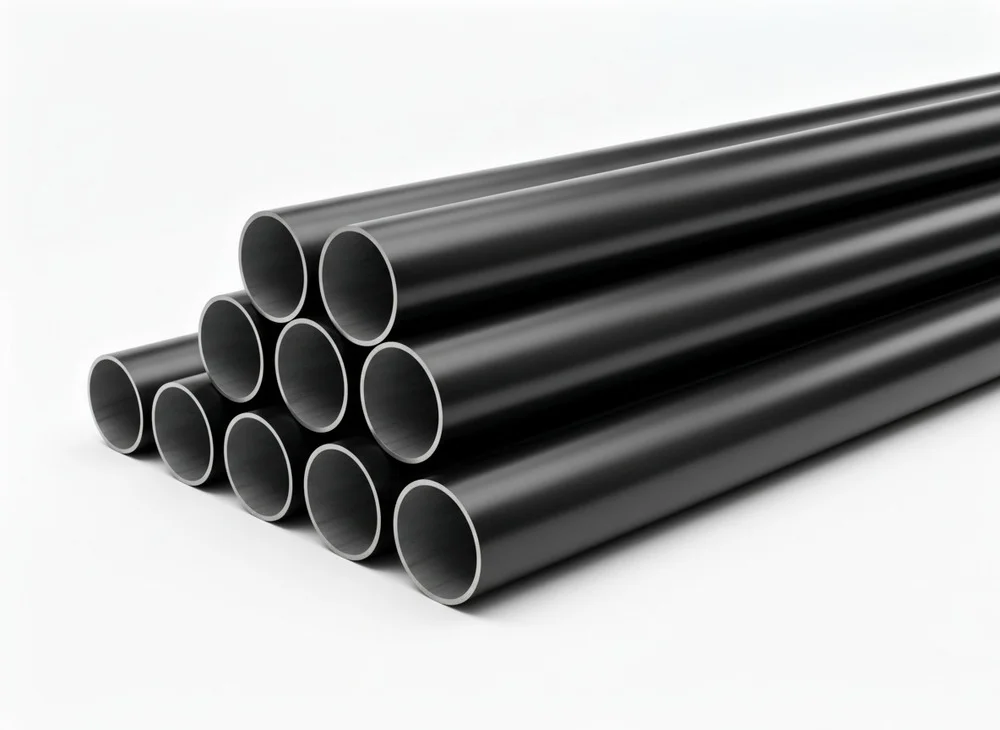
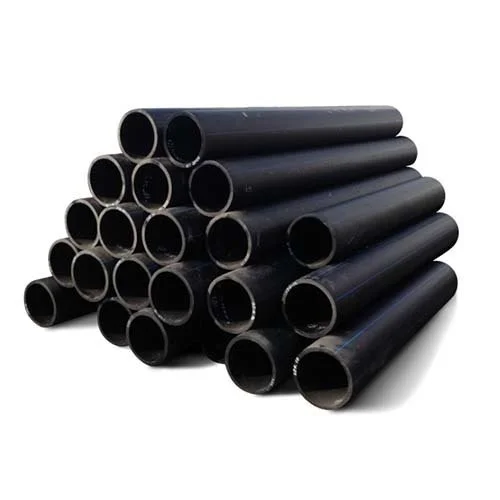
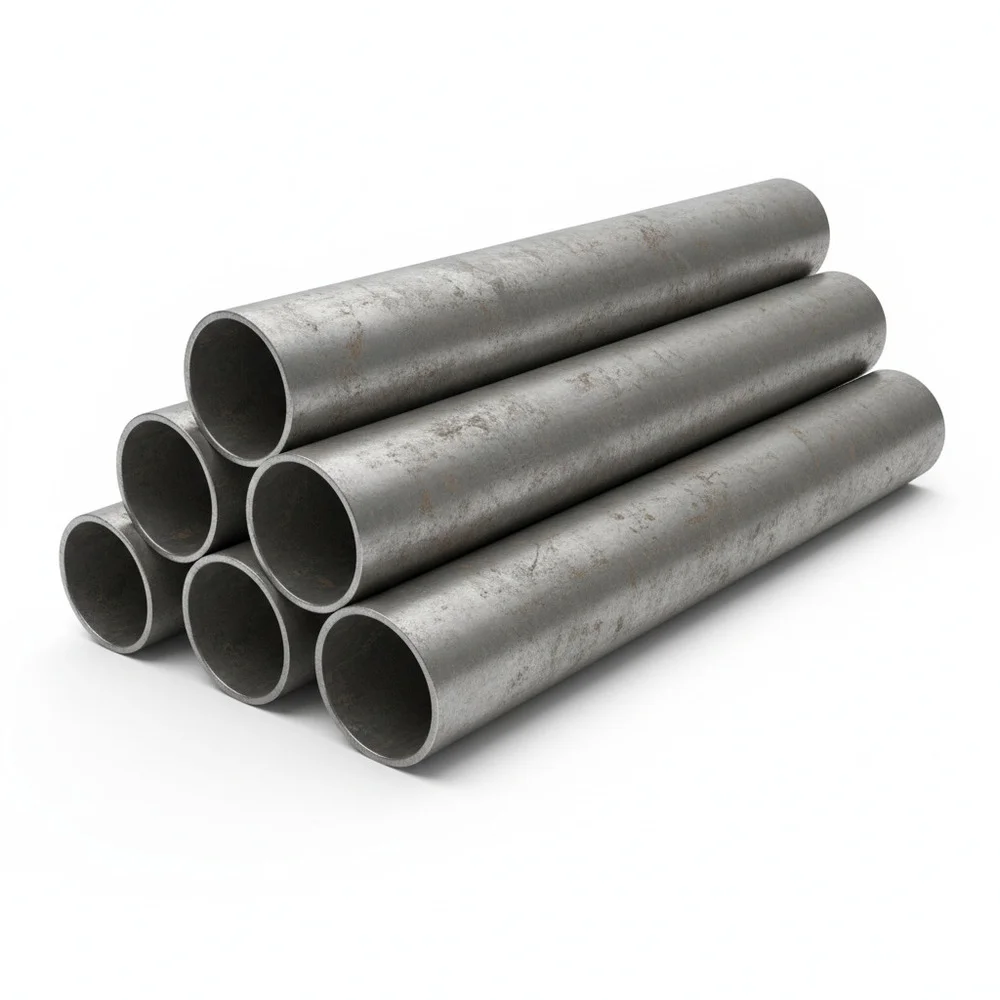
Stainless Steel 316H Pipes and Tubes Specifications
| Parameter |
Details |
| Material | Stainless Steel 316H / UNS S31609 |
| Product forms | Seamless, ERW, EFW, TIG welded |
| Pipe size | ⅛" NPS to 24" NPS |
| Tube OD | 6 mm to 203.2 mm |
| Wall thickness | 0.5 mm to 25 mm |
| Heat treatment | Solution annealed at 1040°C minimum |
| Grain size | ASTM No. 7 or coarser |
| Length | Single random, double random, cut length up to 12 m |
| Ends | Plain, beveled, threaded |
| Surface | Annealed and pickled, bright annealed |
| Tests | Chemical analysis, tensile, flattening, hydrotest or eddy current, PMI |
| Extra tests on request | IGC, ultrasonic, radiography, grain size check |
| Documents | EN 10204 3.1 mill certificate, inspection reports |
Stainless Steel 316H Pipes and Tubes Standards
| Standard |
What it covers |
| ASTM A312 / ASME SA312 | Seamless and welded austenitic pipe |
| ASTM A376 / ASME SA376 | Seamless austenitic pipe for high-temperature central-station service |
| ASTM A213 / ASME SA213 | Seamless boiler, superheater and heat exchanger tubes |
| ASTM A249 / ASME SA249 | Welded boiler and heat exchanger tubes |
| ASTM A358 / ASME SA358 | EFW pipe for high-temperature service |
| ASME B36.19M | Stainless pipe dimensions and schedules |
| ASME B36.10M | Welded and seamless steel pipe dimensions |
| JIS G3459 | Japanese stainless steel pipes |
Material and Grades of Stainless Steel 316H Pipes and Tubes
316H (S31609): The high-carbon grade. Carbon sits between 0.04% and 0.10%, and the pipe is solution annealed at 1040°C or higher so the grain stays coarse. Both features improve strength in the creep range.
316/316H dual certified: One pipe that meets the chemistry of both 316 and 316H. It is the usual way to supply 316H against 316 purchase orders.
316H with controlled grain size: For projects that specify ASTM No. 7 or coarser grain, we confirm the grain size on the test certificate.
All 316H material is supplied in the solution annealed condition, then pickled to remove heat scale.
Stainless Steel 316H vs 316 vs 316L Pipes & Tubes: Which One Do You Need?
| Point |
316H |
316 |
316L |
| Carbon | 0.04–0.10% | 0.08% max | 0.03% max |
| Strength above 500°C | Highest | Moderate | Lowest |
| Grain size | Coarse (No. 7 or coarser) | Not specified | Not specified |
| Welding in wet service | Needs care | Moderate | Best |
| Typical use | Hot, pressurised lines | General corrosion service | Welded, corrosive service |
Choose 316H when the pipe runs hot for long periods and creep strength decides the design. Choose 316L if the line is mainly about corrosion and welding. The higher carbon in 316H gives up some weld and corrosion margin, so it is not the first pick for cold, wet, heavily welded systems.
Stainless Steel 316H Pipes and Tubes Chemical Composition
| Element |
Content (%) |
| Carbon (C) | 0.04 – 0.10 |
| Manganese (Mn) | 2.00 max |
| Silicon (Si) | 1.00 max |
| Phosphorus (P) | 0.045 max |
| Sulphur (S) | 0.030 max |
| Chromium (Cr) | 16.0 – 18.0 |
| Nickel (Ni) | 10.0 – 14.0 |
| Molybdenum (Mo) | 2.00 – 3.00 |
| Iron (Fe) | Balance |
Stainless Steel 316H Pipes and Tubes Mechanical Properties
| Property |
Value |
| Tensile strength | 515 MPa min |
| Yield strength (0.2%) | 205 MPa min |
| Elongation | 35% min |
| Hardness | 90 HRB max (192 HBW) |
| Density | 7.98 g/cm³ |
| Melting range | About 1375 – 1400°C |
| Elastic modulus | About 193 GPa |
| Magnetic response | Non-magnetic when annealed |
High-Temperature Performance of Stainless Steel 316H Pipes and Tubes
| Service temperature |
What to expect |
| Below 425°C | Any 316 grade works. 316L or 316 is usually the cheaper pick. |
| 425°C to about 815°C | 316H territory. Controlled carbon and coarse grain give better creep and rupture strength. |
| 650°C to 900°C for very long periods | Sigma phase can form and reduce toughness once the pipe cools. Check design needs. |
| Above about 815°C | Look at 309, 310S or nickel alloys for better scaling resistance. |
One point is worth knowing before you order. Higher carbon makes 316H more prone to carbide formation after long exposure in the 450–850°C range. For hot service with dry or gas conditions, this is fine. For wet corrosion after welding, 316L or 316Ti is safer.
Stainless Steel 316H Pipes and Tubes Size and Weight Chart
Theoretical weight is (OD − Wall) × Wall × 0.02507, giving kg per metre with dimensions in mm. Real weight varies slightly within mill tolerance.
Pipes (ASME B36.19M and B36.10M)
| NPS |
OD (mm) |
40S wall |
40S kg/m |
80S wall |
80S kg/m |
XXS wall |
XXS kg/m |
| ½" | 21.3 | 2.77 | 1.29 | 3.73 | 1.64 | 7.47 | 2.59 |
| ¾" | 26.7 | 2.87 | 1.71 | 3.91 | 2.23 | 7.82 | 3.70 |
| 1" | 33.4 | 3.38 | 2.54 | 4.55 | 3.29 | 9.09 | 5.54 |
| 1½" | 48.3 | 3.68 | 4.12 | 5.08 | 5.50 | 10.15 | 9.71 |
| 2" | 60.3 | 3.91 | 5.53 | 5.54 | 7.61 | 11.07 | 13.66 |
| 3" | 88.9 | 5.49 | 11.48 | 7.62 | 15.53 | 15.24 | 28.14 |
| 4" | 114.3 | 6.02 | 16.34 | 8.56 | 22.69 | 17.12 | 41.71 |
| 6" | 168.3 | 7.11 | 28.73 | 10.97 | 43.27 | 21.95 | 80.53 |
Heat exchanger and boiler tubes (OD basis)
| OD (mm) |
Wall (mm) |
Weight (kg/m) |
| 19.05 | 2.11 | 0.90 |
| 25.40 | 2.11 | 1.23 |
| 25.40 | 2.77 | 1.57 |
| 31.75 | 2.77 | 2.01 |
| 38.10 | 3.05 | 2.68 |
| 50.80 | 3.05 | 3.65 |
| 63.50 | 3.40 | 5.12 |
| 76.20 | 3.40 | 6.21 |
| 101.60 | 4.19 | 10.23 |
Stainless Steel 316H Pipes and Tubes Sizes, Dimensions and Schedules
Hot-service lines are usually specified in heavier schedules because pressure and temperature work together to stress the wall. The table shows how wall thickness changes with schedule at two common sizes. DN is the metric size for each NPS.
| Schedule |
Wall at 2" / DN 50 (mm) |
Wall at 6" / DN 150 (mm) |
Typical use |
| 10S | 2.77 | 3.40 | Low-pressure hot gas ducts |
| 40S | 3.91 | 7.11 | Standard hot process piping |
| 80S | 5.54 | 10.97 | Steam and high-pressure lines |
| 160 | 8.74 | 18.26 | Very high pressure |
| XXS | 11.07 | 21.95 | Extreme pressure and temperature |
Typical outside diameter tolerance for ASTM A312 pipe is below.
| Pipe size (NPS) |
OD tolerance (mm) |
| ⅛" to 1½" | +0.4 / −0.8 |
| Over 1½" to 4" | +0.8 / −0.8 |
| Over 4" to 8" | +1.6 / −0.8 |
| Over 8" to 18" | +2.4 / −0.8 |
Wall thickness tolerance is −12.5% on A312 pipe. Tubes follow tighter tolerances under A213 and A249. We also cut, bend and prepare ends to your drawing.
Testing and Inspection of Stainless Steel 316H Pipes and Tubes
| Test |
Purpose |
| Chemical analysis | Confirms carbon sits in the 0.04–0.10% band, plus chromium, nickel and molybdenum |
| Tensile and hardness | Checks strength, elongation and hardness |
| Grain size check | Confirms ASTM No. 7 or coarser structure |
| Flattening and flaring (tubes) | Shows tubes deform without cracking |
| Hydrostatic or eddy current | Finds leaks and hidden defects |
| PMI | Confirms the alloy before dispatch |
| IGC to ASTM A262 | Checks resistance to intergranular attack, on request |
| Ultrasonic or radiography | Extra checks for EFW and heavy-wall pipe, on request |
| Dimensional and visual | Checks OD, wall, length, straightness and surface |
Common Materials Supplied with Stainless Steel 316H Pipes and Tubes
We manufacture and supply Stainless Steel 316H Pipes and Tubes along with other stainless steel grades and high-temperature alloys for different industrial applications. Our product range includes:
304H: A high-carbon stainless steel grade suitable for high-temperature piping and industrial equipment.
321H and 347H: Stabilised stainless steel grades used in refinery equipment, power plants, and high-temperature piping systems.
316 and 316L: Stainless steel grades that offer good corrosion resistance for various industrial applications.
316Ti: A titanium-stabilised grade used in applications involving prolonged exposure to elevated temperatures.
309H and 310S: Heat-resistant stainless steel grades suitable for furnaces, heating systems, and high-temperature equipment.
Alloy 800H/HT: Nickel-iron-chromium alloys designed for demanding high-temperature industrial applications.
As experienced Stainless Steel 316H Pipes and Tubes suppliers, we provide material options in different sizes and specifications to meet project requirements. Our range helps customers select suitable materials based on operating temperature, corrosion conditions, and intended use.
Applications of Stainless Steel 316H Pipes and Tubes
- Oil and Gas Refining: Heater tubes, reformer outlets and hot hydrocarbon lines.
- Power Generation: Superheater and reheater sections, steam lines and flue gas ducts.
- Petrochemical: Cracker furnace piping and high-temperature process lines.
- Chemical Processing: Reactor feed lines and hot transfer piping.
- Fertiliser Plants: High-temperature, high-pressure process lines.
- Heat Treatment and Furnaces: Radiant tubes and recuperator parts.
- Boilers and Heat Exchangers: Tubes that run hot under pressure for long periods.
- Waste-to-Energy: Hot gas piping and boiler tubes.
Why Choose Us as Your Stainless Steel 316H Pipes and Tubes Manufacturer in India?
You should choose us because we are a certified manufacturer that makes 316H pipes and tubes itself. We hold ISO 9001:2015 and TÜV certifications and have been in stainless steel manufacturing since 2005. Because our Vasai plant makes the pipe, you deal directly with the manufacturer, which keeps pricing clear and delivery dates honest. As a Stainless Steel 316H Pipes and Tubes Manufacturer and Supplier in India, we handle everything from grade selection to dispatch.
You should also choose us because we control what makes an H grade an H grade. Every heat is checked to confirm carbon sits between 0.04% and 0.10%. Pipes are solution annealed at 1040°C or higher, and grain size is held to ASTM No. 7 or coarser. All of this is recorded on the certificate you receive, so your inspector can verify it without guesswork.
Our range is wide enough to cover a full project. We make seamless, ERW, EFW and TIG welded pipes and tubes from ⅛ inch to 24 inches in ASTM A312, A213, A249 and A376, in standard and heavy schedules. Custom sizes, cut lengths, bends and U-tubes are made to your drawing, and pipes and tubes come from one team under one set of documents.
Finally, you can choose us because we are used to demanding buyers. Every order includes an EN 10204 3.1 certificate, and PMI, IGC testing and third-party inspection are available on request. We export to 85+ countries, so audits, witnessed inspections and export paperwork are part of our everyday work.
Countries We Export Stainless Steel 316H Pipes and Tubes To
As a Stainless Steel 316H Pipes & Tubes Manufacturer and Supplier in India, we export to 85+ countries, serving oil and gas, refining, power generation, petrochemical and chemical industries.
Middle East: UAE, Saudi Arabia, Qatar, Oman, Kuwait and Bahrain.
Europe: Germany, Italy, United Kingdom, Netherlands, France, Spain, Belgium and Poland.
Asia-Pacific: Singapore, Malaysia, Indonesia, Thailand, Vietnam, South Korea, Japan and Australia.
Americas: USA, Canada, Mexico, Brazil and Chile.
Africa: South Africa, Nigeria, Egypt and Kenya.
South Asia: Nepal, Bangladesh and Sri Lanka.
EN 10204 3.1 mill test certificates come with every order. EN 10204 3.2 certification and third-party inspection can be arranged on request. We pack each shipment to suit its route and destination, and we prepare the shipping and export documents your project requires, so international orders move cleanly from our plant to your site.