
Steel Pipe Weight Chart
Steel Pipe Weight Chart
Use this steel pipe weight chart to find the weight of steel pipes by size, outside diameter, wall thickness, and schedule. Whether you need to calculate the weight of a single pipe or estimate the total weight of a bulk order, the chart helps you get the figures you need quickly. It includes steel pipe weight per metre, weight per 6-metre or 12-metre length, and approximate metres per tonne. You can use these values to estimate material quantities, compare pipe sizes, and plan transportation and project costs. Simply select the relevant pipe dimensions and check the corresponding weight. For the most accurate estimate, make sure the pipe dimensions and material specifications match your requirements, as actual weight can vary slightly from theoretical values due to manufacturing tolerances.
What Are Steel Pipes?
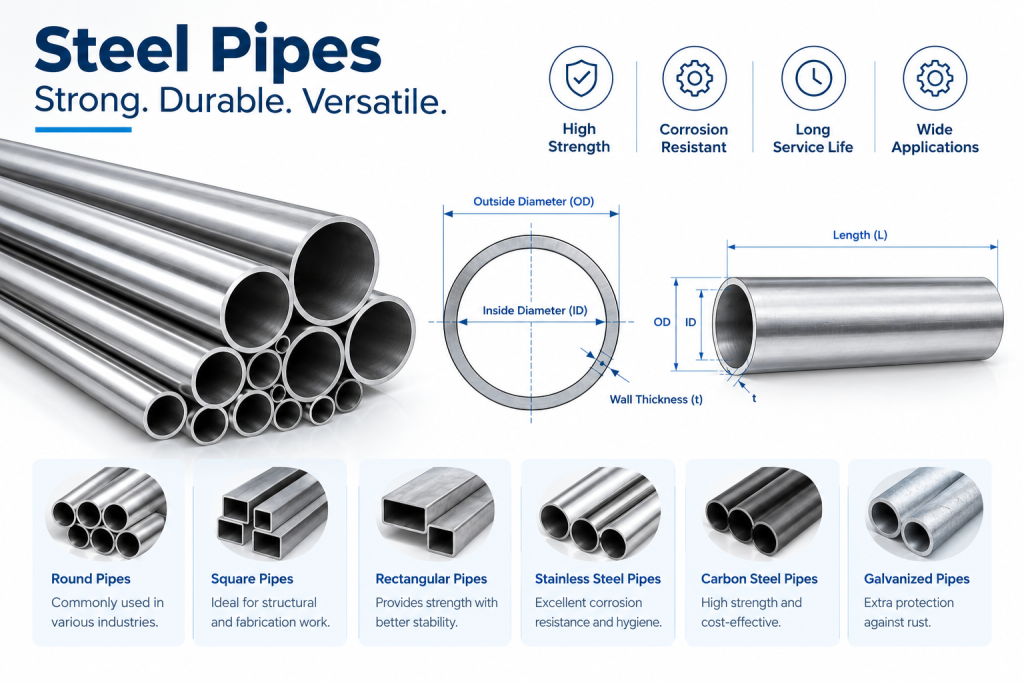
Steel pipes are hollow cylindrical products made from steel, designed to transport liquids, gases, and steam or to support structural loads. They come in different diameters, wall thicknesses, and grades to meet the needs of construction, manufacturing, oil and gas, water supply, and other industries.
Steel pipes are commonly available as seamless or welded pipes, including ERW (Electric Resistance Welded) pipes. The right type depends on the working pressure, temperature, corrosion conditions, and intended application.
When choosing a steel pipe, its outside diameter, wall thickness, length, and material grade help determine its strength, capacity, and weight. A steel pipe weight chart makes it easier to calculate the weight per metre or per length, estimate material quantities, and plan purchasing and transportation costs.
Get Certified Steel Pipes at Competitive Factory Prices
How to Calculate Steel Pipe Weight
You can calculate steel pipe weight using two measurements: the outside diameter (OD) and wall thickness. Once you know these dimensions, use the appropriate formula to estimate the pipe’s weight per metre or per foot.
Metric formula (kg/m):
Weight = (OD − Wall Thickness) × Wall Thickness × 0.02466
Use OD and wall thickness in millimetres for carbon and alloy steel.
Imperial formula (lb/ft):
Weight = 10.69 × (OD − Wall Thickness) × Wall Thickness
Use both measurements in inches.
Example: A 2-inch Schedule 40 steel pipe has an OD of 60.3 mm and a wall thickness of 3.91 mm. Its approximate weight is:
(60.3 − 3.91) × 3.91 × 0.02466 = 5.44 kg/m
For stainless steel 304, use a factor of approximately 0.02491 instead of 0.02466.
Quick conversions:
- 1 kg/m ≈ 0.672 lb/ft
- 1 lb/ft ≈ 1.488 kg/m
Steel Pipe Weight at a Glance
Here are the pipes people ask about most. These are Schedule 40 carbon steel pipes.
| Pipe size | OD (mm) | Wall (mm) | kg per metre | kg per 6 m pipe |
|---|---|---|---|---|
| 1/2" | 21.3 | 2.77 | 1.27 | 7.6 |
| 1" | 33.4 | 3.38 | 2.50 | 15.0 |
| 2" | 60.3 | 3.91 | 5.44 | 32.6 |
| 3" | 88.9 | 5.49 | 11.29 | 67.7 |
| 4" | 114.3 | 6.02 | 16.07 | 96.4 |
| 6" | 168.3 | 7.11 | 28.26 | 169.6 |
| 8" | 219.1 | 8.18 | 42.55 | 255.3 |
| 12" | 323.9 | 10.31 | 79.73 | 478.4 |
Carbon Steel Pipe Weight Chart (½" to 4")
Weights are in kg per metre, plain end, per ASME B36.10M.
| Size | NB | OD (mm) | Sch 10 | Sch 40 / STD | Sch 80 / XS | Sch 160 | XXS |
|---|---|---|---|---|---|---|---|
| 1/8" | 6 | 10.3 | 0.28 | 0.37 | 0.47 | – | – |
| 1/4" | 8 | 13.7 | 0.49 | 0.63 | 0.80 | – | – |
| 3/8" | 10 | 17.1 | 0.63 | 0.84 | 1.10 | – | – |
| 1/2" | 15 | 21.3 | 1.00 | 1.27 | 1.62 | 1.95 | 2.55 |
| 3/4" | 20 | 26.7 | 1.28 | 1.69 | 2.20 | 2.90 | 3.64 |
| 1" | 25 | 33.4 | 2.09 | 2.50 | 3.24 | 4.24 | 5.45 |
| 1 1/4" | 32 | 42.2 | 2.69 | 3.39 | 4.47 | 5.61 | 7.77 |
| 1 1/2" | 40 | 48.3 | 3.11 | 4.05 | 5.41 | 7.25 | 9.55 |
| 2" | 50 | 60.3 | 3.93 | 5.44 | 7.48 | 11.11 | 13.44 |
| 2 1/2" | 65 | 73.0 | 5.26 | 8.63 | 11.41 | 14.92 | 20.39 |
| 3" | 80 | 88.9 | 6.46 | 11.29 | 15.27 | 21.35 | 27.68 |
| 4" | 100 | 114.3 | 8.37 | 16.07 | 22.32 | 33.54 | 41.03 |
Carbon Steel Pipe Weight Chart (5" to 24")
Big pipes get heavy fast, so check this table before you plan transport.
| Size | NB | OD (mm) | Sch 10 | Sch 40 / STD | Sch 80 / XS | Sch 160 | XXS |
|---|---|---|---|---|---|---|---|
| 5" | 125 | 141.3 | 11.56 | 21.77 | 30.97 | 49.12 | 57.43 |
| 6" | 150 | 168.3 | 13.83 | 28.26 | 42.56 | 67.56 | 79.22 |
| 8" | 200 | 219.1 | 19.97 | 42.55 | 64.64 | 111.27 | 107.93 |
| 10" | 250 | 273.1 | 27.78 | 60.31 | 96.01 | 172.33 | 155.15 |
| 12" | 300 | 323.9 | 35.99 | 79.73 | 132.08 | 238.76 | 186.97 |
| 14" | 350 | 355.6 | 54.69 | 94.54 | 158.10 | 281.70 | – |
| 16" | 400 | 406.4 | 62.64 | 123.30 | 203.50 | 365.40 | – |
| 18" | 450 | 457.2 | 70.60 | 155.90 | 254.70 | 459.60 | – |
| 20" | 500 | 508.0 | 78.55 | 183.40 | 311.20 | 564.80 | – |
| 24" | 600 | 609.6 | 94.46 | 255.30 | 441.80 | 807.60 | – |
Weight of Other Schedules (8", 10" and 12")
These sizes have many more schedules in use. Weights are in kg per metre.
| Schedule | 8" (219.1 mm) | 10" (273.1 mm) | 12" (323.9 mm) |
|---|---|---|---|
| Sch 20 | 33.31 | 41.77 | 49.73 |
| Sch 30 | 36.82 | 51.03 | 65.20 |
| Sch 60 | 53.08 | 81.55 | 108.96 |
| Sch 100 | 75.91 | 114.75 | 159.91 |
| Sch 120 | 90.44 | 133.06 | – |
| Sch 140 | 100.93 | 155.15 | 208.14 |
Steel Pipe Weight in kg/m and lb/ft (Sch 40 and Sch 80)
Use this when your drawing is in imperial units.
| Size | OD (inch) | Sch 40 kg/m | Sch 40 lb/ft | Sch 80 kg/m | Sch 80 lb/ft |
|---|---|---|---|---|---|
| 1/2" | 0.840 | 1.27 | 0.85 | 1.62 | 1.09 |
| 3/4" | 1.050 | 1.69 | 1.13 | 2.20 | 1.48 |
| 1" | 1.315 | 2.50 | 1.68 | 3.24 | 2.17 |
| 1 1/4" | 1.660 | 3.39 | 2.27 | 4.47 | 3.00 |
| 1 1/2" | 1.900 | 4.05 | 2.72 | 5.41 | 3.63 |
| 2" | 2.375 | 5.44 | 3.65 | 7.48 | 5.02 |
| 2 1/2" | 2.875 | 8.63 | 5.79 | 11.41 | 7.66 |
| 3" | 3.500 | 11.29 | 7.58 | 15.27 | 10.25 |
| 4" | 4.500 | 16.07 | 10.79 | 22.32 | 14.98 |
| 6" | 6.625 | 28.26 | 18.97 | 42.56 | 28.57 |
| 8" | 8.625 | 42.55 | 28.55 | 64.64 | 43.39 |
| 10" | 10.750 | 60.31 | 40.48 | 96.01 | 64.33 |
| 12" | 12.750 | 79.73 | 53.52 | 132.08 | 88.63 |
Stainless Steel Pipe Weight Chart (304, 5S to 80S)
Stainless steel is a little denser than carbon steel, so it weighs about 1% more at the same size. Weights are in kg per metre for 304, per ASME B36.19M.
| Size | NB | OD (mm) | 5S | 10S | 40S | 80S |
|---|---|---|---|---|---|---|
| 1/2" | 15 | 21.3 | 0.81 | 1.01 | 1.28 | 1.63 |
| 1" | 25 | 33.4 | 1.31 | 2.11 | 2.53 | 3.27 |
| 2" | 50 | 60.3 | 2.41 | 3.97 | 5.49 | 7.56 |
| 3" | 80 | 88.9 | 4.56 | 6.52 | 11.41 | 15.43 |
| 4" | 100 | 114.3 | 5.90 | 8.45 | 16.24 | 22.55 |
| 6" | 150 | 168.3 | 11.42 | 13.97 | 28.55 | 42.99 |
| 8" | 200 | 219.1 | 14.93 | 20.17 | 42.98 | 65.30 |
| 10" | 250 | 273.1 | 22.84 | 28.07 | 60.92 | 82.38 |
| 12" | 300 | 323.9 | 31.56 | 36.35 | 74.63 | 98.45 |
For 316 and 316L, add about 0.6% on top of these figures.
Weight Factor for Other Materials
Got a carbon steel weight and need another material? Multiply by the factor below. Or use the constant in the formula instead of 0.02466.
| Material | Typical density (kg/m³) | Formula constant | Multiply carbon steel weight by |
|---|---|---|---|
| Carbon steel / alloy steel | 7850 | 0.02466 | 1.000 |
| Stainless steel 304 | 7930 | 0.02491 | 1.010 |
| Stainless steel 316 / 316L | 7980 | 0.02507 | 1.017 |
| Stainless steel 321 | 7900 | 0.02482 | 1.006 |
| Duplex 2205 / super duplex | 7800 | 0.02450 | 0.994 |
| Inconel 600 | 8470 | 0.02661 | 1.079 |
| Monel 400 | 8800 | 0.02765 | 1.121 |
| Cupro nickel 90/10 | 8900 | 0.02796 | 1.134 |
| Titanium Gr 2 | 4510 | 0.01417 | 0.574 |
| Aluminium | 2700 | 0.00848 | 0.344 |
Densities are typical values. Check the mill certificate for the exact grade.
Water-Filled Pipe Weight (Sch 40)
When you design supports or plan a hydrotest, you need the weight of the pipe plus the water inside it. Weights are in kg per metre.
| Size | Empty pipe | Water inside | Total (pipe + water) |
|---|---|---|---|
| 1/2" | 1.27 | 0.20 | 1.47 |
| 1" | 2.50 | 0.56 | 3.06 |
| 2" | 5.44 | 2.17 | 7.61 |
| 3" | 11.29 | 4.77 | 16.06 |
| 4" | 16.07 | 8.22 | 24.29 |
| 6" | 28.26 | 18.65 | 46.91 |
| 8" | 42.55 | 32.27 | 74.82 |
| 10" | 60.31 | 50.91 | 111.22 |
| 12" | 79.73 | 72.25 | 151.98 |
Water is taken at 1000 kg/m³. For 12 inch pipe, the water weighs almost as much as the steel.
How Many Metres Are in One Tonne? (Sch 40)
| Size | kg per metre | Metres per tonne |
|---|---|---|
| 1/2" | 1.27 | 787 |
| 1" | 2.50 | 400 |
| 2" | 5.44 | 184 |
| 3" | 11.29 | 89 |
| 4" | 16.07 | 62 |
| 6" | 28.26 | 35 |
| 8" | 42.55 | 23.5 |
| 10" | 60.31 | 16.6 |
| 12" | 79.73 | 12.5 |
MS Pipe Weight Chart (IS 1239, Light, Medium and Heavy)
Indian water, gas and steam pipes use classes instead of schedules. Each cell shows kg per metre, with wall thickness in mm in brackets.
| NB | OD (mm) | Light | Medium | Heavy |
|---|---|---|---|---|
| 15 | 21.3 | 0.95 (2.0) | 1.20 (2.6) | 1.43 (3.2) |
| 20 | 26.9 | 1.40 (2.3) | 1.56 (2.6) | 1.87 (3.2) |
| 25 | 33.7 | 1.99 (2.6) | 2.41 (3.2) | 2.93 (4.0) |
| 32 | 42.4 | 2.55 (2.6) | 3.09 (3.2) | 3.79 (4.0) |
| 40 | 48.3 | 3.25 (2.9) | 3.56 (3.2) | 4.37 (4.0) |
| 50 | 60.3 | 4.11 (2.9) | 5.03 (3.6) | 6.19 (4.5) |
| 65 | 76.1 | 5.75 (3.2) | 6.44 (3.6) | 7.95 (4.5) |
| 80 | 88.9 | 6.76 (3.2) | 8.37 (4.0) | 9.96 (4.8) |
| 100 | 114.3 | 9.83 (3.6) | 12.18 (4.5) | 14.50 (5.4) |
| 150 | 165.1 | – | 18.98 (4.8) | 21.27 (5.4) |
Large ERW Steel Pipe Weight Chart (IS 3589)
Weights in kg per metre.
| OD (mm) | Size | 6 mm wall | 8 mm wall | 10 mm wall | 12 mm wall |
|---|---|---|---|---|---|
| 168.3 | 6" | 24.01 | 31.62 | 39.04 | 46.25 |
| 219.1 | 8" | 31.53 | 41.65 | 51.57 | 61.29 |
| 273.1 | 10" | 39.52 | 52.30 | 64.88 | 77.27 |
| 323.9 | 12" | 47.04 | 62.32 | 77.41 | 92.30 |
| 355.6 | 14" | 51.73 | 68.57 | 85.22 | 101.68 |
| 406.4 | 16" | 59.24 | 78.60 | 97.75 | 116.71 |
| 457.0 | 18" | 66.73 | 88.58 | 110.23 | 131.68 |
| 508.0 | 20" | 74.28 | 98.64 | 122.81 | 146.78 |
Steel Pipe Weight by OD and Wall Thickness
If your pipe is not a standard schedule, find your OD and wall here. Weights are in kg per metre, carbon steel.
| OD (mm) | 3 mm | 5 mm | 8 mm | 10 mm | 12.5 mm |
|---|---|---|---|---|---|
| 33.4 | 2.25 | 3.50 | 5.01 | 5.77 | – |
| 60.3 | 4.24 | 6.82 | 10.32 | 12.40 | 14.73 |
| 88.9 | 6.36 | 10.34 | 15.96 | 19.46 | 23.55 |
| 114.3 | 8.23 | 13.48 | 20.97 | 25.72 | 31.38 |
| 168.3 | 12.23 | 20.13 | 31.62 | 39.04 | 48.03 |
| 219.1 | 15.99 | 26.40 | 41.65 | 51.57 | 63.68 |
| 273.1 | 19.98 | 33.06 | 52.30 | 64.88 | 80.33 |
| 323.9 | 23.74 | 39.32 | 62.32 | 77.41 | 95.99 |
Steel Tube Weight Chart (Small OD, 304 Stainless)
Tubes are sized by actual OD and wall, not by NB. Weights are in kg per metre.
| OD (mm) | OD (inch) | Wall (mm) | ID (mm) | kg/m |
|---|---|---|---|---|
| 6.35 | 1/4" | 0.89 | 4.57 | 0.12 |
| 6.35 | 1/4" | 1.24 | 3.87 | 0.16 |
| 9.53 | 3/8" | 1.24 | 7.05 | 0.26 |
| 9.53 | 3/8" | 1.65 | 6.23 | 0.32 |
| 12.70 | 1/2" | 1.24 | 10.22 | 0.35 |
| 12.70 | 1/2" | 1.65 | 9.40 | 0.45 |
| 12.70 | 1/2" | 2.11 | 8.48 | 0.56 |
| 19.05 | 3/4" | 1.65 | 15.75 | 0.72 |
| 19.05 | 3/4" | 2.11 | 14.83 | 0.89 |
| 25.40 | 1" | 1.65 | 22.10 | 0.98 |
| 25.40 | 1" | 2.11 | 21.18 | 1.22 |
| 25.40 | 1" | 2.77 | 19.86 | 1.56 |
| 38.10 | 1 1/2" | 1.65 | 34.80 | 1.50 |
| 38.10 | 1 1/2" | 2.11 | 33.88 | 1.89 |
| 50.80 | 2" | 1.65 | 47.50 | 2.02 |
| 50.80 | 2" | 2.11 | 46.58 | 2.56 |
Square and Rectangular Steel Pipe Weight Chart
Weights in kg per metre, carbon steel. Corner radii make real weight 2 to 3% different.
| Size (mm) | 2 mm wall | 3 mm wall | 4 mm wall | 5 mm wall |
|---|---|---|---|---|
| 25 × 25 | 1.44 | 2.07 | 2.64 | – |
| 40 × 40 | 2.39 | 3.49 | 4.52 | 5.50 |
| 50 × 50 | 3.01 | 4.43 | 5.78 | 7.07 |
| 60 × 60 | 3.64 | 5.37 | 7.03 | 8.63 |
| 80 × 80 | 4.90 | 7.25 | 9.55 | 11.78 |
| 100 × 100 | 6.15 | 9.14 | 12.06 | 14.92 |
| 50 × 25 | 2.23 | 3.25 | 4.21 | – |
| 60 × 40 | 3.01 | 4.43 | 5.78 | 7.07 |
| 80 × 40 | 3.64 | 5.37 | 7.03 | 8.64 |
| 100 × 50 | 4.58 | 6.78 | 8.92 | 10.99 |
Formulas (mm):
Why Actual Steel Pipe Weight May Differ
A steel pipe weight chart provides an estimated weight, but the actual weight can vary depending on a few factors:
- Wall thickness: Small variations in the pipe wall during manufacturing can change its overall weight.
- Pipe ends: Threading, bevelled edges, and sockets can slightly affect the final weight.
- Protective coating: Galvanising adds extra weight to the pipe.
- Material grade: Stainless steel grades, such as 316, may weigh differently from carbon steel due to differences in material density.
For preliminary cost estimates, you can allow a small margin for weight variations. For bulk orders, confirm the supplier’s weight calculation and billing method before placing the order. If billing depends on actual weight, ask whether the supplier uses weighbridge measurements or theoretical pipe weight.
Common Mistakes When Using a Steel Pipe Weight Chart
A steel pipe weight chart is useful for quick calculations, but choosing the wrong dimensions can lead to incorrect results. Watch out for these common mistakes:
- Ignoring the pipe schedule: The same nominal bore can have different weights depending on the schedule and wall thickness.
- Using the wrong material: Stainless steel and carbon steel may have different weights for the same pipe dimensions.
- Confusing Sch 40 and STD: These specifications do not always have the same wall thickness, especially in larger pipe sizes.
- Mixing measurement units: Check whether the outside diameter is listed in millimetres or inches before calculating.
- Ignoring the weight of water: When designing pipe supports, include the weight of the pipe, contents, insulation, and other fittings where applicable.
Steel Pipes for Industrial and Commercial Applications
Find steel pipes to suit your project requirements, with options in carbon steel, stainless steel, and alloy steel across a range of sizes, wall thicknesses, and schedules. These pipes serve various applications, including construction, oil and gas, power generation, fabrication, and industrial fluid transportation.
To request a quotation, share your required pipe size, schedule, material grade, and quantity. This information helps confirm product availability, estimated weight, and suitable specifications for your application.
For domestic and international orders, check the applicable material standards and documentation requirements before purchasing. EN 10204 3.1 material test certificates can help verify the chemical composition and mechanical properties of the supplied material. Always confirm certificate availability, delivery details, and weight-based billing terms when finalising your order.