
MS Pipes Weight Chart
MS Pipes Weight Chart
An MS Pipes Weight Chart makes it easier to estimate pipe weight before purchasing materials for construction, fabrication, or industrial projects. By checking the pipe diameter, wall thickness, and length, you can calculate the approximate weight and plan your material requirements more accurately.
This MS pipe weight chart covers different pipe sizes and specifications, with weight listed per metre and per standard 6-metre length. It also helps you estimate how many metres of pipe make up one tonne, making it useful for bulk orders, transportation planning, and cost calculations.
You can use the chart to check the weight of round MS pipes, large ERW pipes, and schedule pipes, along with square and rectangular mild steel sections. Since pipe weight depends on dimensions and wall thickness, always select the correct specification when comparing values. The chart provides theoretical weights for easy reference; actual weights may vary slightly due to manufacturing tolerances.
What Is an MS Pipe?
An MS pipe, or mild steel pipe, is manufactured from low-carbon steel known for its strength, durability, weldability, and versatility. MS pipes are widely used in India for water supply, gas distribution, steam and air lines, structural frameworks, scaffolding, and fire-fighting systems.
Depending on the application and required specifications, mild steel pipes are available in different manufacturing types, including electric resistance welded (ERW), hot-finished welded, and seamless pipes.
Small and medium-sized MS pipes commonly follow IS 1239 standards, while larger-diameter pipes may be manufactured as per IS 3589. Schedule pipes are generally specified according to standards such as ASME B36.10M, ASTM A53, and ASTM A106, depending on the pipe type and application.
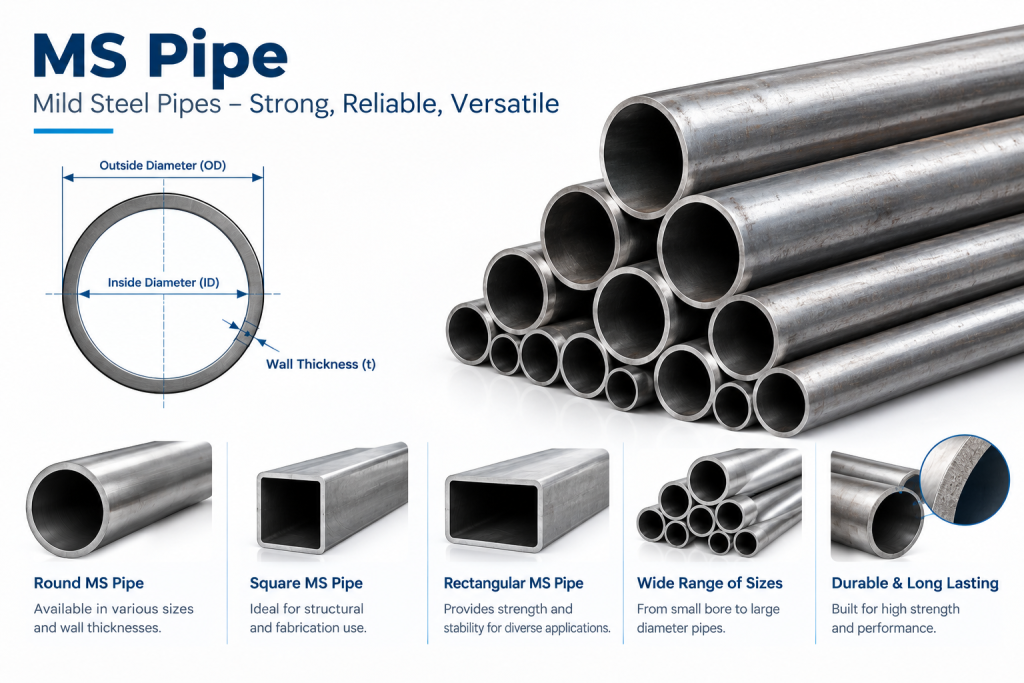
Get Certified MS Pipe at Competitive Factory Prices
Why MS Pipe Weight Charts Show Different Numbers
Search for the weight of a 1 inch Medium class pipe and you will see answers from about 2.2 to 2.6 kg/m. They cannot all be right. These are the usual reasons:
- Old and new wall values. Older IS 1239 charts use 2.65 and 3.25 mm walls. Current dimensions use 2.6 and 3.2 mm. A small change in wall moves the weight by 1 to 2%.
- Two OD standards. Some charts use 33.4 mm for a 25 NB pipe. IS 1239 uses 33.7 mm. The same goes for 26.7 vs 26.9 mm and 42.2 vs 42.4 mm.
- Wrong wall picked. A few charts show a Light wall next to a Medium label, or the other way round.
- Rounding and units. Some tables skip the units, or give weight per 6 m without saying so.
- Tolerance mixed in. A few sources quote weight after cutting 10% for wall tolerance. That is a lower bound, not the nominal weight.
Every figure on this page uses current IS 1239 (Part 1) walls and ODs, a density of 7850 kg/m³, and the formula in the calculation section below. These are theoretical weights for plain end pipe.
MS Pipe Weight Formula (Kg per Meter)
Use this formula for any round MS pipe:
Weight (kg/m) = (OD − Wall) × Wall × 0.02466
OD and wall thickness are in mm. The factor 0.02466 comes from π × 7850 (the density of mild steel in kg/m³) × 10⁻⁶.
Example 1: 2″ medium class pipe, OD 60.3 mm, wall 3.6 mm.
(60.3 − 3.6) × 3.6 × 0.02466 = 5.03 kg/m. For one 6 m length, that is 30.2 kg.
Example 2: 12″ ERW pipe, OD 323.9 mm, wall 9.53 mm, length 18 m.
(323.9 − 9.53) × 9.53 × 0.02466 = 73.88 kg/m. Total = 73.88 × 18 = about 1,330 kg.
Quick conversions:
- kg/m × 0.672 = lb/ft
- kg/m × 6 = weight of one 6 m pipe
- kg × 0.001 = tonnes
MS Pipe Weight Chart in Kg per Meter (IS 1239 Light, Medium, Heavy)
IS 1239 (Part 1) pipes come in three classes. Light is Class A, Medium is Class B and Heavy is Class C. Weights below are calculated for plain end pipe.
| NB (mm) | Inch | OD (mm) | Light wall (mm) | Light kg/m | Medium wall (mm) | Medium kg/m | Heavy wall (mm) | Heavy kg/m |
|---|---|---|---|---|---|---|---|---|
| 15 | 1/2" | 21.3 | 2.0 | 0.95 | 2.6 | 1.20 | 3.2 | 1.43 |
| 20 | 3/4" | 26.9 | 2.3 | 1.40 | 2.6 | 1.56 | 3.2 | 1.87 |
| 25 | 1" | 33.7 | 2.6 | 1.99 | 3.2 | 2.41 | 4.0 | 2.93 |
| 32 | 1 1/4" | 42.4 | 2.6 | 2.55 | 3.2 | 3.09 | 4.0 | 3.79 |
| 40 | 1 1/2" | 48.3 | 2.9 | 3.25 | 3.2 | 3.56 | 4.0 | 4.37 |
| 50 | 2" | 60.3 | 2.9 | 4.11 | 3.6 | 5.03 | 4.5 | 6.19 |
| 65 | 2 1/2" | 76.1 | 3.2 | 5.75 | 3.6 | 6.44 | 4.5 | 7.95 |
| 80 | 3" | 88.9 | 3.2 | 6.76 | 4.0 | 8.37 | 4.8 | 9.96 |
| 100 | 4" | 114.3 | 3.6 | 9.83 | 4.5 | 12.18 | 5.4 | 14.50 |
| 125 | 5" | 139.7 | – | – | 4.8 | 15.97 | 5.4 | 17.88 |
| 150 | 6" | 165.1 | – | – | 4.8 | 18.98 | 5.4 | 21.27 |
Colour code: Light pipes are marked yellow, Medium blue and Heavy red.
Rule of thumb: Heavy (Class C) is the heaviest. It can be 15 to 30% heavier than Light in the same size, so always confirm the class before ordering.
MS Round Pipe Weight Chart by OD and Thickness (Kg per Meter)
Use this chart when you know the OD and the wall you want. Values are calculated for mild steel at 7850 kg/m³.
| OD (mm) | 2.0 mm | 2.6 mm | 3.2 mm | 4.0 mm | 5.0 mm |
|---|---|---|---|---|---|
| 21.3 | 0.95 | 1.20 | 1.43 | 1.71 | 2.01 |
| 26.9 | 1.23 | 1.56 | 1.87 | 2.26 | 2.70 |
| 33.7 | 1.56 | 1.99 | 2.41 | 2.93 | 3.54 |
| 42.4 | 1.99 | 2.55 | 3.09 | 3.79 | 4.61 |
| 48.3 | 2.28 | 2.93 | 3.56 | 4.37 | 5.34 |
| 60.3 | 2.88 | 3.70 | 4.51 | 5.55 | 6.82 |
| 76.1 | 3.65 | 4.71 | 5.75 | 7.11 | 8.77 |
| 88.9 | 4.29 | 5.53 | 6.76 | 8.37 | 10.34 |
| 114.3 | 5.54 | 7.16 | 8.77 | 10.88 | 13.48 |
MS ERW Pipe Weight Chart (IS 3589, 6" to 24")
IS 3589 covers larger MS pipes used in water supply, sewage, oil, gas and structures. Weights in kg per metre:
| OD (mm) | NB | 5.0 mm | 6.0 mm | 8.0 mm | 10.0 mm | 12.0 mm |
|---|---|---|---|---|---|---|
| 168.3 | 6" | 20.13 | 24.01 | 31.62 | 39.04 | 46.25 |
| 219.1 | 8" | 26.40 | 31.53 | 41.65 | 51.57 | 61.29 |
| 273.1 | 10" | 33.06 | 39.52 | 52.30 | 64.88 | 77.27 |
| 323.9 | 12" | 39.32 | 47.04 | 62.32 | 77.41 | 92.30 |
| 355.6 | 14" | 43.23 | 51.73 | 68.57 | 85.22 | 101.68 |
| 406.4 | 16" | 49.49 | 59.24 | 78.60 | 97.75 | 116.71 |
| 457.0 | 18" | 55.73 | 66.73 | 88.58 | 110.23 | 131.68 |
| 508.0 | 20" | 62.02 | 74.28 | 98.64 | 122.81 | 146.78 |
| 609.6 | 24" | – | 89.31 | 118.68 | 147.86 | 176.84 |
MS Pipe Schedule Weight Chart (Sch 40 and Sch 80)
For plant piping built to ASME B36.10M, use this MS pipe schedule weight chart. It shows weight per metre and per 6 m length.
| NPS | NB | OD (mm) | Sch 40 wall (mm) | Sch 40 kg/m | Sch 40 kg / 6 m | Sch 80 wall (mm) | Sch 80 kg/m | Sch 80 kg / 6 m |
|---|---|---|---|---|---|---|---|---|
| 1/2" | 15 | 21.3 | 2.77 | 1.27 | 7.62 | 3.73 | 1.62 | 9.72 |
| 3/4" | 20 | 26.7 | 2.87 | 1.69 | 10.14 | 3.91 | 2.20 | 13.20 |
| 1" | 25 | 33.4 | 3.38 | 2.50 | 15.00 | 4.55 | 3.24 | 19.44 |
| 1 1/4" | 32 | 42.2 | 3.56 | 3.39 | 20.34 | 4.85 | 4.47 | 26.82 |
| 1 1/2" | 40 | 48.3 | 3.68 | 4.05 | 24.30 | 5.08 | 5.41 | 32.46 |
| 2" | 50 | 60.3 | 3.91 | 5.44 | 32.64 | 5.54 | 7.48 | 44.88 |
| 2 1/2" | 65 | 73.0 | 5.16 | 8.63 | 51.78 | 7.01 | 11.41 | 68.46 |
| 3" | 80 | 88.9 | 5.49 | 11.29 | 67.74 | 7.62 | 15.27 | 91.62 |
| 4" | 100 | 114.3 | 6.02 | 16.07 | 96.42 | 8.56 | 22.32 | 133.92 |
| 6" | 150 | 168.3 | 7.11 | 28.26 | 169.56 | 10.97 | 42.56 | 255.36 |
| 8" | 200 | 219.1 | 8.18 | 42.55 | 255.30 | 12.70 | 64.64 | 387.84 |
| 10" | 250 | 273.1 | 9.27 | 60.31 | 361.86 | 15.09 | 96.01 | 576.06 |
| 12" | 300 | 323.9 | 10.31 | 79.73 | 478.38 | 17.48 | 132.08 | 792.48 |
Heavy wall (Sch 160) weight in kg/m:
| NPS | NB | Sch 160 wall (mm) | Sch 160 kg/m |
|---|---|---|---|
| 1/2" | 15 | 4.78 | 1.95 |
| 1" | 25 | 6.35 | 4.24 |
| 2" | 50 | 8.74 | 11.11 |
| 3" | 80 | 11.13 | 21.35 |
| 4" | 100 | 13.49 | 33.54 |
| 6" | 150 | 18.26 | 67.56 |
| 8" | 200 | 23.01 | 111.27 |
MS Hollow Pipe Weight Chart (Square and Rectangular)
MS hollow sections are also called square and rectangular pipes. They are common in frames, gates, trusses and furniture.
Formulas (dimensions in mm, weight in kg/m):
Here a and b are the sides, and t is the wall. Corner radii cause a small difference from mill weight, usually 2 to 3%.
| Size (mm) | Wall (mm) | Weight (kg/m) |
|---|---|---|
| 20 × 20 | 1.6 | 0.92 |
| 20 × 20 | 2.0 | 1.13 |
| 25 × 25 | 2.0 | 1.44 |
| 25 × 25 | 2.5 | 1.77 |
| 40 × 40 | 2.0 | 2.39 |
| 40 × 40 | 3.0 | 3.49 |
| 50 × 50 | 2.5 | 3.73 |
| 50 × 50 | 3.0 | 4.43 |
| 60 × 60 | 3.0 | 5.37 |
| 60 × 60 | 4.0 | 7.03 |
| 80 × 80 | 3.0 | 7.25 |
| 80 × 80 | 4.0 | 9.55 |
| 100 × 100 | 4.0 | 12.06 |
| 100 × 100 | 5.0 | 14.92 |
| 50 × 25 | 2.0 | 2.23 |
| 60 × 40 | 2.5 | 3.73 |
| 80 × 40 | 3.0 | 5.37 |
| 100 × 50 | 3.0 | 6.78 |
Why Actual MS Pipe Weight May Vary
The MS pipe weight chart gives an estimated weight based on standard dimensions. However, the weight of the pipe you receive may differ slightly due to manufacturing and finishing processes.
- Wall thickness: Small changes in wall thickness can increase or reduce the pipe’s weight.
- Surface coating: Galvanised MS pipes weigh more than uncoated pipes because of the zinc layer.
- Pipe design: Threaded ends, sockets, and bevelled edges can affect the final weight.
- Manufacturing method: ERW and seamless pipes may have slight differences in actual dimensions and weight.
- Pipe length: Longer pipes weigh more, so always check the actual length before comparing weights.
For accurate MS pipe weight calculations and project costing, use the chart as a reference and confirm the actual dimensions and weight with your supplier.
How to Calculate MS Pipe Weight Using the Chart
The MS pipe weight chart helps you estimate the total material weight before purchasing. First, match the pipe’s diameter and thickness with the correct entry in the chart. Then use the weight per metre to work out the total quantity required.
For example: If one 3-inch Schedule 40 pipe weighs 67.74 kg for a 6-metre length, 200 pipes will weigh approximately 13,548 kg, or 13.55 tonnes.
Always check the pipe specifications and length before calculating the final weight, as these directly affect your material requirement and cost.
How Many Metres or Pipes in One Tonne of MS Pipe?
Buyers often order by tonne and need to know the length. This table uses Medium class pipe.
| NB | Inch | kg/m | Metres per tonne | 6 m pipes per tonne |
|---|---|---|---|---|
| 15 | 1/2" | 1.20 | 833 | 139 |
| 20 | 3/4" | 1.56 | 641 | 107 |
| 25 | 1" | 2.41 | 415 | 69 |
| 32 | 1 1/4" | 3.09 | 324 | 54 |
| 40 | 1 1/2" | 3.56 | 281 | 47 |
| 50 | 2" | 5.03 | 199 | 33 |
| 65 | 2 1/2" | 6.44 | 155 | 26 |
| 80 | 3" | 8.37 | 120 | 20 |
| 100 | 4" | 12.18 | 82 | 14 |
| 150 | 6" | 18.98 | 53 | 9 |
To go the other way, multiply the metres you need by the kg/m value. For 600 m of 2" Medium pipe, that is 600 × 5.03 = 3,018 kg, or about 3 tonnes.
How Much Heavier Is Sch 80 Than Sch 40?
Going up a schedule adds wall, and the extra weight grows with pipe size. Weights are carbon steel, plain end, kg/m.
| NB | Inch | Sch 40 | Sch 80 | Extra weight in Sch 80 |
|---|---|---|---|---|
| 15 | 1/2" | 1.27 | 1.62 | +28% |
| 20 | 3/4" | 1.69 | 2.20 | +30% |
| 25 | 1" | 2.50 | 3.24 | +30% |
| 32 | 1 1/4" | 3.39 | 4.47 | +32% |
| 40 | 1 1/2" | 4.05 | 5.41 | +34% |
| 50 | 2" | 5.44 | 7.48 | +38% |
| 65 | 2 1/2" | 8.63 | 11.41 | +32% |
| 80 | 3" | 11.29 | 15.27 | +35% |
| 100 | 4" | 16.07 | 22.32 | +39% |
| 150 | 6" | 28.26 | 42.56 | +51% |
| 200 | 8" | 42.55 | 64.64 | +52% |
| 250 | 10" | 60.31 | 96.01 | +59% |
| 300 | 12" | 79.73 | 132.08 | +66% |
So switching a 12" line from Sch 40 to Sch 80 adds about two-thirds more steel. Check this before you finalise freight and support design.
Checklist Before Ordering MS Pipes by Weight
Before placing an MS pipe order, check these details to avoid quantity mismatches, unexpected costs, and material issues.
- Confirm the pipe diameter, wall thickness, and grade.
- Verify the applicable IS standard or schedule.
- Check whether the quoted weight is theoretical or actual.
- Confirm the pipe length and total number of pieces.
- Ask whether galvanising or other coatings are included.
- Clarify weight tolerance and billing terms with the supplier.
- Compare the total quoted weight with your project requirements.
- Check the material test certificate and inspection requirements, if applicable.
Source MS Pipes for Your Project
Looking for the right MS pipes for your industrial or construction requirements? Choose from mild steel and carbon steel pipes available in round, square, and rectangular sections to suit different applications. Whether you need pipes for structural work, fabrication, scaffolding, or general engineering, selecting the correct size and thickness helps ensure the right fit for your project.
To get a suitable quotation, share your required pipe diameter, class or wall thickness, and order quantity. You can also specify the required length and applicable standards to help confirm product availability and estimated weight.
With supply capabilities covering more than 85+ countries, orders can be arranged for domestic and international requirements. EN 10204 3.1 material test certificates are available for applicable products and orders. Check your MS pipe specifications carefully before ordering to help avoid weight discrepancies and ensure the material meets your project needs.