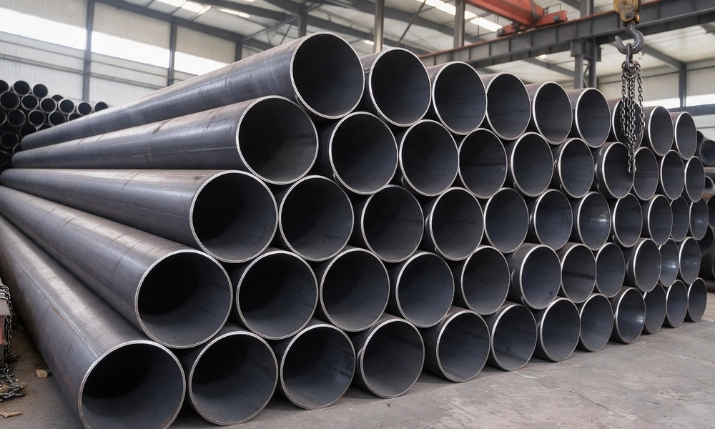
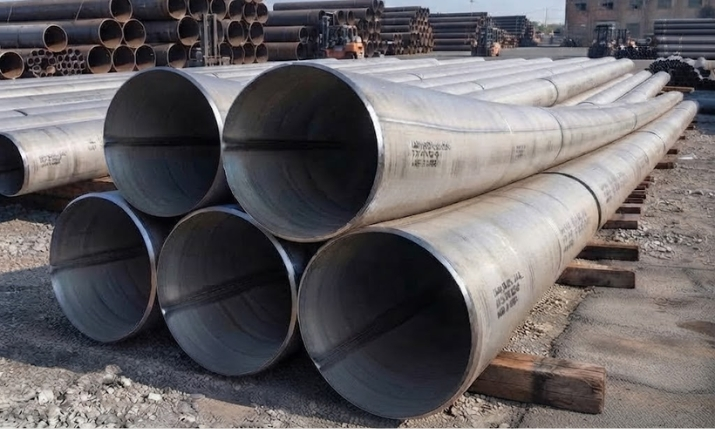
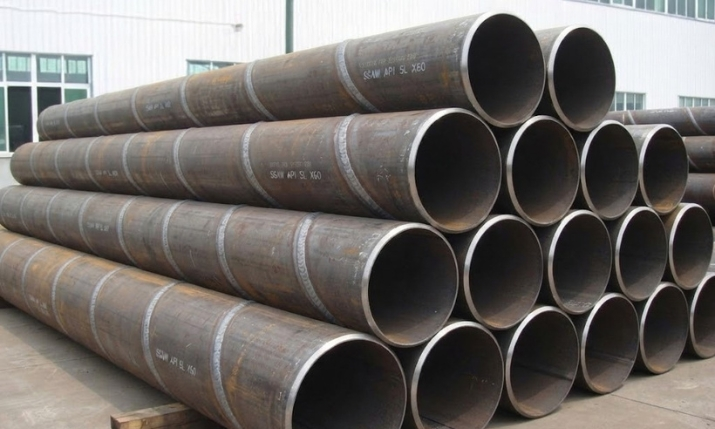
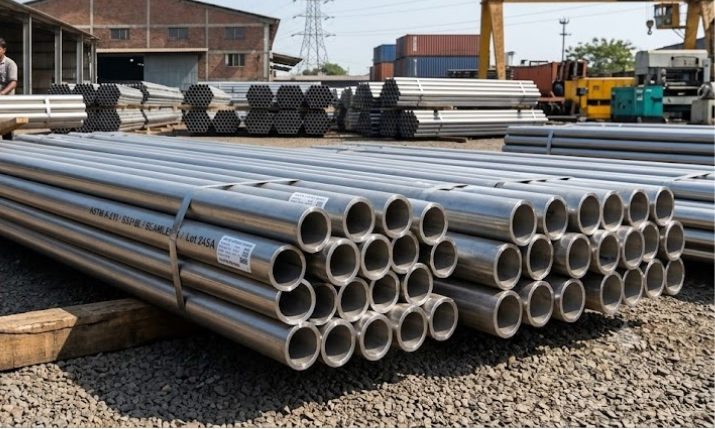
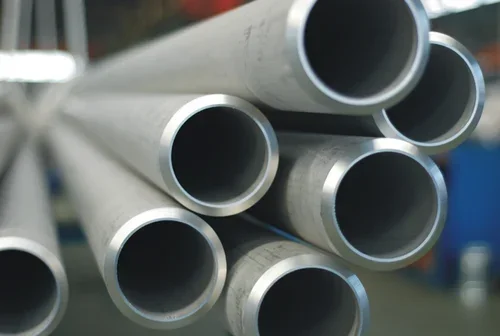
API 5L X60 Carbon Steel Pipes Specifications
| Parameter |
Details |
| Grade | API 5L X60 / ISO 3183 L415 |
| Product levels | PSL 1 and PSL 2 |
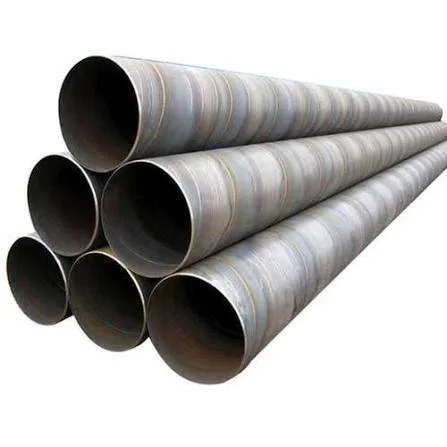
| Manufacturing routes | Seamless, HFW, LSAW, SSAW |
| Pipe size | ⅛" NPS to 24" NPS, larger on request |
| Wall thickness | 2.11 mm to 50 mm |
| Delivery condition | PSL 1: as-rolled or normalised. PSL 2: X60N, X60Q or X60M |
| Length | R1 (about 4.9 to 7.6 m), R2 (about 10.7 to 13.7 m), fixed length on request |
| Ends | Plain, beveled |
| Coating | Black, varnish, epoxy, FBE or 3LPE on request |
| Tests | Hydrostatic, tensile, flattening or bend, chemical analysis |
| PSL 2 tests | Charpy impact, weld NDT, product analysis, DWTT on request |
| Documents | EN 10204 3.1 mill certificate, inspection reports |
API 5L X60 Carbon Steel Pipes Standards
| Standard |
Role |
| API Specification 5L | Governs manufacture, testing and marking of line pipe |
| ISO 3183 | The international edition of API 5L |
| ASME B31.8 | Design of gas transmission and distribution pipelines |
| ASME B31.4 | Design of liquid pipeline systems |
| API 1104 | Welding of pipelines and related facilities |
| ASME B36.10M | Pipe dimensions and schedules |
| ASME B16.25 | Butt-welding end preparation |
Material and Grades of API 5L X60 Carbon Steel Pipes
X60 sits in the middle of the API 5L X series, above X52 and X56 and below X65 and X70. Steelmakers reach 415 MPa without raising carbon, using micro-alloying and controlled rolling. That keeps the steel tough and weldable.
PSL 1 follows the basic requirements. PSL 2 adds a lower carbon cap, tighter sulphur and phosphorus, a carbon equivalent limit, a ceiling on strength and mandatory impact testing. Market surveys put PSL 2 at roughly 5–15% above PSL 1 in cost, which buyers accept when the line is critical.
The delivery condition decides how the steel gets its strength:
| Suffix |
Delivery condition |
Typical use for X60 |
| N | Normalised | Seamless and some welded pipe, with uniform grain |
| Q | Quenched and tempered | Seamless pipe needing higher toughness |
| M | Thermomechanically rolled | Welded pipe made from controlled-rolled plate or coil |
Tell us the suffix your specification names, and whether the fluid is sour, since sour service adds chemistry, hardness and testing limits that we confirm at enquiry.
API 5L X60 Carbon Steel Pipes Chemical Composition
| Element |
PSL 1 seamless (%) |
PSL 1 welded (%) |
PSL 2 seamless (%) |
PSL 2 welded (%) |
| Carbon (C) | 0.28 max | 0.26 max | 0.24 max | 0.22 max |
| Manganese (Mn) | 1.40 max | 1.40 max | 1.40 max | 1.40 max |
| Phosphorus (P) | 0.030 max | 0.030 max | 0.025 max | 0.025 max |
| Sulphur (S) | 0.030 max | 0.030 max | 0.015 max | 0.015 max |
| Niobium + vanadium + titanium | 0.15 max | 0.15 max | 0.15 max | 0.15 max |
| Carbon equivalent (IIW) | – | – | 0.43 max | 0.43 max |
| Carbon equivalent (Pcm) | – | – | 0.25 max | 0.25 max |
Individual limits on niobium, vanadium and titanium, and other residuals, follow the standard.
API 5L X60 Carbon Steel Pipes Mechanical Properties
| Property |
PSL 1 |
PSL 2 |
| Yield strength | 415 MPa min (60,200 psi) | 415 to 565 MPa |
| Tensile strength | 520 MPa min (75,400 psi) | 520 to 760 MPa |
| Yield to tensile ratio | Not specified | 0.93 max |
| Elongation | Calculated from the standard's formula for the wall and strip width | Same |
| Charpy impact | Not required | Required, with minimum energy from the standard |
| Density | About 7.85 g/cm³ | About 7.85 g/cm³ |
Toughness and Fracture Control in API 5L X60 Carbon Steel Pipes
Strength is only half the story in a high-pressure gas line. If a crack starts, it can run along the pipe at hundreds of metres per second, and in an unlucky line it can travel kilometres. This is called unstable ductile fracture, and pipe toughness is what stops it.
Two tests matter. The Charpy V-notch test hits a small notched bar and measures the energy it absorbs, which shows how tough the steel is at a chosen temperature. The drop-weight tear test (DWTT) breaks a full-thickness specimen and reports how much of the fracture surface is ductile. Gas pipeline designers often ask for a high DWTT shear area, such as 85%, at the minimum design temperature.
As grade and diameter go up, the toughness a line needs goes up too. That is why PSL 2 is the usual choice for X60 gas transmission. When you order, tell us the minimum design temperature, the Charpy energy and the DWTT requirement, so the steel can be made and tested to match.
API 5L X60 vs X52 vs X65 vs X70 Pipes: Which Grade Pays Off?
The table compares the wall needed for a 36-inch line at 100 bar, using t = P × D ÷ (2 × SMYS × F), with a design factor of 0.72 and no corrosion allowance.
| Grade |
Minimum yield |
Wall needed |
Weight (kg/m) |
Steel per km |
| X52 | 360 MPa | 17.64 mm | 390.09 | 390 t |
| X60 | 415 MPa | 15.30 mm | 339.23 | 339 t |
| X65 | 450 MPa | 14.11 mm | 313.26 | 313 t |
| X70 | 485 MPa | 13.09 mm | 290.94 | 291 t |
Moving from X52 to X60 saves about 13% of the steel, or roughly 51 tonnes per kilometre. X65 and X70 save more, but they need tighter welding control and more demanding toughness. X60 is often the sweet spot where the saving is real and field welding stays practical. Whether the higher grades pay off depends on the extra cost per tonne, so run both options through your cost model.
API 5L X60 Carbon Steel Pipes Size and Weight Chart
Weight per metre is (OD − Wall) × Wall × 0.02466, with dimensions in mm. Mill tolerances move the real weight slightly.
| NPS |
OD (mm) |
12.70 mm wall kg/m |
15.88 mm wall kg/m |
19.05 mm wall kg/m |
| 16" | 406.4 | 123.30 | 152.93 | 181.97 |
| 20" | 508.0 | 155.12 | 192.71 | 229.70 |
| 24" | 609.6 | 186.94 | 232.50 | 277.42 |
| 30" | 762.0 | 234.67 | 292.18 | 349.02 |
| 36" | 914.4 | 282.40 | 351.86 | 420.61 |
| 42" | 1066.8 | 330.13 | 411.54 | 492.20 |
| 48" | 1219.2 | 377.85 | 471.22 | 563.80 |
Sizes, Dimensions and Ordering Details of API 5L X60 Carbon Steel Pipes
Line pipe is ordered by outside diameter and wall in millimetres or inches, not by schedule. API 5L lets pipe body diameter vary by ±0.75% from 60.3 mm up to 610 mm and by ±0.5% above that. Wall tolerance on seamless pipe up to 25 mm is +15% and −12.5%. The details below prevent most ordering mistakes.
| Detail |
Why it matters |
| OD and wall, with tolerance basis | Says whether the wall is a nominal or a minimum, which changes the thickness you receive |
| PSL level | Sets chemistry, testing and traceability |
| Delivery condition suffix | N, Q or M decides strength route and toughness |
| Manufacturing route | Seamless, HFW, LSAW or SSAW, based on size and pressure |
| Length range | R1, R2 or fixed length, to match your logistics |
| End preparation | Bevel angle, root face and land for your welding procedure |
| Minimum design temperature | Sets the Charpy and DWTT test temperature |
| Coating system | FBE, 3LPE or primer, with cutback length |
| Supplementary requirements | Sour service, NDT extent, extra tests or witnessing |
Field Welding of API 5L X60 Carbon Steel Pipes
X60 welds well in the field, but it rewards a good procedure. Pipelines are joined under API 1104, which covers welder qualification, procedure testing and inspection.
The PSL 2 carbon equivalent limit keeps the steel from hardening too much in the heat-affected zone, which lowers the risk of hydrogen cracking. Even so, preheat and interpass temperature should be set by the procedure, based on wall, ambient conditions and joint restraint. Many crews use cellulosic electrodes for the root and hot pass, then low-hydrogen electrodes or mechanised gas metal arc welding for fill and cap, with consumables chosen to match or slightly overmatch the pipe strength.
Because welded joints on X60 can be a little stronger or weaker than the pipe, it helps to tell us your welding process at enquiry. We can then check that the pipe chemistry and delivery condition suit it.
Testing and Inspection of API 5L X60 Carbon Steel Pipes
Every length of X60 is hydrostatically tested to API 5L. The test proves the pipe holds pressure with no leakage and is the single most important check before the pipe leaves the plant. Tensile tests then confirm yield and tensile strength against the 415 MPa and 520 MPa minimums, and flattening or guided bend tests show that the pipe and its weld can deform without cracking.
Chemical analysis checks heat and product chemistry against the PSL limits, including carbon, manganese, sulphur, phosphorus and the micro-alloy elements. On PSL 2 pipe, Charpy impact tests confirm toughness at the temperature you specify, and welded pipe gets NDT of the seam. DWTT is added when your specification calls for it.
Dimensional and visual checks cover diameter, wall, straightness, ovality and surface defects. If your project needs independent witnessing, third-party inspection can follow your inspection and test plan.
Common Materials Supplied with API 5L X60 Carbon Steel Pipes
Pipeline construction often requires several pipe grades and connection components to suit different operating conditions. Alongside API 5L X60 Carbon Steel Pipes, we offer complementary piping products for transmission lines, processing facilities, and industrial projects.
API 5L X52 and X56 Pipes: Suitable for pipeline sections where these grades meet the specified strength and design requirements.
API 5L X65 and X70 Pipes: Higher-strength line pipe grades used in transmission projects designed for their respective material properties.
API 5L Grade B and X42 Pipes: Used in pipeline and plant applications where their specified mechanical properties meet service requirements.
ASTM A106 Grade B and C Pipes: Seamless carbon steel pipes for high-temperature service within the applicable grade limits.
ASTM A333 Grade 6 Pipes: Designed for low-temperature applications requiring specified impact toughness.
Pipe Bends, Tees, and Reducers: Used to change pipeline direction, create branches, and connect different pipe diameters.
Weld-Neck Flanges: Provide welded connections between piping sections, valves, and equipment.
These products help meet different pipeline design and installation needs. Experienced API 5L X60 Carbon Steel Pipes Suppliers can coordinate compatible grades, fittings, and flanges according to the project's dimensions, operating conditions, and applicable standards.
Applications of API 5L X60 Carbon Steel Pipes
- Gas Transmission Pipelines: High-pressure onshore trunk lines carrying natural gas over long distances.
- Crude Oil Trunk Lines: Large-diameter lines moving crude between fields, terminals and refineries.
- Refined Product Pipelines: Long-distance transport of petrol, diesel and jet fuel.
- Pipeline Uprates and Loops: Replacement and looping sections that carry more flow at higher pressure.
- Compressor and Pump Stations: Station piping, headers and manifolds.
- Offshore Landfalls and Risers: Heavy-wall sections where high strength saves weight.
- Water Transmission: Large mains where high pressure or long spans need strong pipe.
- Structural and Piling Work: Pipe piles and heavy supports where strength-to-weight matters.
Why Choose Us as Your API 5L X60 Carbon Steel Pipes Manufacturer in India?
We manufacture and export API 5L X60 Carbon Steel Pipes for high-strength pipeline applications across the oil and gas, energy, and industrial sectors. With experience dating back to 2005, a production capacity of 100 tons per month, and exports to 85+ countries, we support projects with varied pipe dimensions and technical requirements.
Our range includes seamless and welded line pipes in PSL 1 and PSL 2 specifications, with different wall thicknesses and end preparations. We hold ISO 9001:2015 and TÜV certifications and provide EN 10204 Type 3.1 material test certificates. Additional testing and third-party inspections can be arranged according to agreed project requirements.
We also supply other API 5L grades, ASTM A106 and ASTM A333 pipes, carbon steel fittings, and flanges. From material selection to export documentation, we coordinate orders according to the specified standards and delivery requirements. If you need an API 5L X60 Carbon Steel Pipes Supplier in India, we can help you identify suitable pipe options based on your required size, wall thickness, PSL level, and coating specifications.
Countries We Export API 5L X60 Carbon Steel Pipes To
Our export operations extend to 85+ countries, supplying API 5L X60 Carbon Steel Pipes for pipeline development, oil and gas transportation, and large-scale industrial projects. We work with international customers to meet specified requirements for pipe grades, dimensions, wall thicknesses, and protective coatings.
Middle East: UAE, Saudi Arabia, Oman, Qatar, Bahrain, and Kuwait.
Europe: France, Germany, Italy, Belgium, Poland, Spain, and the United Kingdom.
Asia-Pacific: Japan, Australia, Singapore, Indonesia, Vietnam, Malaysia, and South Korea.
North and South America: Canada, USA, Mexico, Brazil, Argentina, and Chile.
Africa: Egypt, South Africa, Nigeria, Morocco, and Kenya.
South Asia: Nepal, Sri Lanka, and Bangladesh.
We prepare export orders according to the destination country's shipping and documentation requirements. This includes suitable packing, material certification, and coordination of agreed inspections before dispatch. By aligning supply arrangements with each project's technical specifications and delivery needs, we support international customers sourcing API 5L X60 Carbon Steel Pipes for demanding pipeline applications.