
ERW Steel Pipe Weight Chart
ERW Steel Pipe Weight Chart
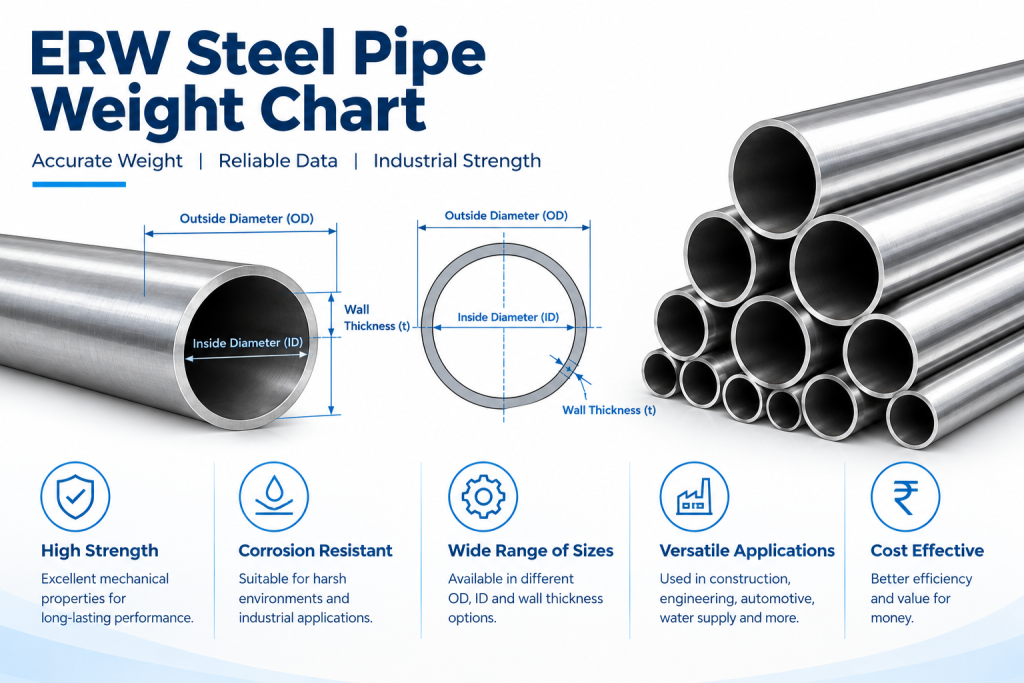
An ERW steel pipe weight chart tells you how much each meter of electric resistance welded pipe weighs, so you can plan material, freight and cost with confidence. This chart lists nominal bore, outside diameter, wall thickness and theoretical weight in kg/m for every common size. It covers IS 1239 light, medium and heavy class pipes, ASME B36.10 schedule pipes in SCH 40, 80 and 160, and large diameter pipes under IS 3589. You also get the weight formula with worked examples, an SWG to mm thickness table, odd size weights and tolerance limits. Mild steel has a density of 7.85 g/cm³, and every figure here follows that value. Use the data to check mill test certificates, estimate truck loads, and calculate the exact weight of pipes cut to length, whether you buy a single bundle or a full container.
What Is ERW Steel Pipe Weight Chart?
An ERW steel pipe weight chart is a table that shows how much an ERW pipe weighs for each size. You pick the pipe size and wall thickness, and the chart gives you the weight in kg per meter.
ERW pipes are made by Electric Resistance Welding, and the weight follows a simple rule. A thicker wall or a bigger diameter means more steel, so the pipe weighs more. The chart does this math for you, so you do not need to calculate every size by hand.
You can use the chart to work out the weight of a full pipe length, estimate freight and truck loads, compare quotes, and check the weight on a mill test certificate. Most charts follow IS 1239 for light, medium and heavy pipes, and ASME B36.10 for schedule pipes.
Get Certified ERW Steel Pipe at Competitive Factory Prices
ERW Steel Pipe Weight Formula
Use this formula to get the weight of any ERW pipe in kg per meter.
Weight (kg/m) = (OD − WT) × WT × 0.02466
OD is the outside diameter in mm, and WT is the wall thickness in mm. The constant 0.02466 comes from the density of mild steel, which is 7.85 g/cm³ or 7,850 kg/m³. To get the total weight, multiply the result by the pipe length in meters.
Worked example 1: 60.3 mm OD × 3.6 mm wall (2″ NB, medium class)
(60.3 − 3.6) × 3.6 × 0.02466 = 5.03 kg/m. A 6 m pipe weighs about 30.2 kg.
Worked example 2: 219.1 mm OD × 8 mm wall (IS 3589)
(219.1 − 8) × 8 × 0.02466 = 41.65 kg/m. A 12 m pipe weighs about 499.8 kg.
To convert kg/m to lb/ft, multiply by 0.672. The results are theoretical, plain end, black pipe values. Galvanizing adds roughly 5 to 6 percent to the weight.
ERW Pipe Weight Chart in KG per Meter as per IS 1239
This table gives the weight in kg/m for light, medium and heavy class ERW pipes as per IS 1239 Part 1.
| NB (mm) | OD (mm) | Light WT (mm) | Light kg/m | Medium WT (mm) | Medium kg/m | Heavy WT (mm) | Heavy kg/m |
|---|---|---|---|---|---|---|---|
| 15 | 21.3 | 2.0 | 0.95 | 2.6 | 1.20 | 3.2 | 1.43 |
| 20 | 26.9 | 2.3 | 1.40 | 2.6 | 1.56 | 3.2 | 1.87 |
| 25 | 33.7 | 2.6 | 1.99 | 3.2 | 2.41 | 4.0 | 2.93 |
| 32 | 42.4 | 2.6 | 2.55 | 3.2 | 3.09 | 4.0 | 3.79 |
| 40 | 48.3 | 2.9 | 3.25 | 3.2 | 3.56 | 4.0 | 4.37 |
| 50 | 60.3 | 2.9 | 4.10 | 3.6 | 5.03 | 4.5 | 6.19 |
| 65 | 76.1 | 3.2 | 5.75 | 3.6 | 6.44 | 4.5 | 7.95 |
| 80 | 88.9 | 3.2 | 6.76 | 4.0 | 8.37 | 4.8 | 9.95 |
| 100 | 114.3 | 3.6 | 9.83 | 4.5 | 12.18 | 5.4 | 14.50 |
| 125 | 139.7 | – | – | 4.8 | 15.97 | 5.4 | 17.88 |
| 150 | 165.1 | – | – | 4.8 | 18.97 | 5.4 | 21.27 |
Values are calculated from the formula. Tabulated figures in the standard can differ by less than 2 percent because of rounding.
ERW Pipe Weight per Piece and Pieces per Tonne
Knowing the weight of one 6 m length helps you estimate truck loads and bundle counts.
| NB (mm) | OD (mm) | WT (mm) | kg/m | kg per 6 m pipe | Pieces per tonne |
|---|---|---|---|---|---|
| 15 | 21.3 | 2.6 | 1.20 | 7.2 | 139 |
| 20 | 26.9 | 2.6 | 1.56 | 9.3 | 107 |
| 25 | 33.7 | 3.2 | 2.41 | 14.4 | 69 |
| 32 | 42.4 | 3.2 | 3.09 | 18.6 | 54 |
| 40 | 48.3 | 3.2 | 3.56 | 21.4 | 47 |
| 50 | 60.3 | 3.6 | 5.03 | 30.2 | 33 |
| 65 | 76.1 | 3.6 | 6.44 | 38.6 | 26 |
| 80 | 88.9 | 4.0 | 8.37 | 50.2 | 20 |
| 100 | 114.3 | 4.5 | 12.18 | 73.1 | 14 |
| 125 | 139.7 | 4.8 | 15.97 | 95.8 | 10 |
| 150 | 165.1 | 4.8 | 18.97 | 113.8 | 9 |
ERW Pipe Schedule Chart: SCH 40, SCH 80 and SCH 160 Weight
Schedule pipes follow ASME B36.10 and ASTM A53, and the wall gets thicker as the schedule number rises.
| NPS (inch) | OD (mm) | SCH 40 WT (mm) | SCH 40 kg/m | SCH 80 WT (mm) | SCH 80 kg/m | SCH 160 WT (mm) | SCH 160 kg/m |
|---|---|---|---|---|---|---|---|
| 1/2 | 21.3 | 2.77 | 1.27 | 3.73 | 1.62 | 4.78 | 1.95 |
| 3/4 | 26.7 | 2.87 | 1.69 | 3.91 | 2.20 | 5.56 | 2.90 |
| 1 | 33.4 | 3.38 | 2.50 | 4.55 | 3.24 | 6.35 | 4.24 |
| 1-1/2 | 48.3 | 3.68 | 4.05 | 5.08 | 5.41 | 7.14 | 7.25 |
| 2 | 60.3 | 3.91 | 5.44 | 5.54 | 7.48 | 8.74 | 11.11 |
| 3 | 88.9 | 5.49 | 11.29 | 7.62 | 15.27 | 11.13 | 21.35 |
| 4 | 114.3 | 6.02 | 16.07 | 8.56 | 22.32 | 13.49 | 33.54 |
| 6 | 168.3 | 7.11 | 28.26 | 10.97 | 42.56 | 14.27 | 54.20 |
| 8 | 219.1 | 8.18 | 42.55 | 12.70 | 64.64 | 23.01 | 111.27 |
| 10 | 273.1 | 9.27 | 60.31 | 15.09 | 96.01 | 28.58 | 172.33 |
| 12 | 323.9 | 10.31 | 79.73 | 17.48 | 132.08 | 33.32 | 238.76 |
Moving from SCH 40 to SCH 80 adds about 30 to 50 percent more steel per meter, depending on the size. SCH 160 can add up to 3 times the weight of SCH 40 on larger sizes.
ERW Pipe Thickness Chart (SWG to mm)
Thin wall ERW pipes for furniture, poles and structures are often ordered by SWG gauge, so this table converts gauge to mm and inch.
| SWG | Thickness (mm) | Thickness (inch) |
|---|---|---|
| 10 | 3.25 | 0.128 |
| 11 | 2.95 | 0.116 |
| 12 | 2.64 | 0.104 |
| 13 | 2.34 | 0.092 |
| 14 | 2.03 | 0.080 |
| 15 | 1.83 | 0.072 |
| 16 | 1.63 | 0.064 |
| 17 | 1.42 | 0.056 |
| 18 | 1.22 | 0.048 |
| 19 | 1.02 | 0.040 |
| 20 | 0.91 | 0.036 |
IS 3589 Large Diameter ERW Pipe Weight Chart
IS 3589 covers large diameter ERW pipes from 168.3 mm up to 2,540 mm OD, used for water, gas and oil lines.
| OD (mm) | 6 mm WT (kg/m) | 8 mm WT (kg/m) | 10 mm WT (kg/m) | 12.7 mm WT (kg/m) |
|---|---|---|---|---|
| 168.3 | 24.0 | 31.6 | 39.0 | 48.7 |
| 219.1 | 31.5 | 41.6 | 51.6 | 64.6 |
| 273.0 | 39.5 | 52.3 | 64.9 | 81.5 |
| 323.9 | 47.0 | 62.3 | 77.4 | 97.5 |
| 355.6 | 51.7 | 68.6 | 85.2 | 107.4 |
| 406.4 | 59.2 | 78.6 | 97.8 | 123.3 |
| 457.0 | 66.7 | 88.6 | 110.2 | 139.1 |
| 508.0 | 74.3 | 98.6 | 122.8 | 155.1 |
| 610.0 | 89.4 | 118.8 | 148.0 | 187.1 |
| 762.0 | 111.9 | 148.7 | 185.4 | 234.7 |
| 914.0 | 134.3 | 178.7 | 222.9 | 282.3 |
| 1016.0 | 149.4 | 198.9 | 248.1 | 314.2 |
Weight of Odd Size ERW Pipes
Odd size pipes fall outside the standard NB series, so you work out their weight with the same formula. The table below covers common inch-based tube sizes.
| OD (mm) | 1.6 mm WT (kg/m) | 2.0 mm WT (kg/m) | 2.5 mm WT (kg/m) | 3.0 mm WT (kg/m) |
|---|---|---|---|---|
| 25.4 | 0.94 | 1.15 | 1.41 | 1.66 |
| 31.8 | 1.19 | 1.47 | 1.81 | 2.13 |
| 38.1 | 1.44 | 1.78 | 2.19 | 2.60 |
| 44.5 | 1.69 | 2.10 | 2.59 | 3.07 |
| 50.8 | 1.94 | 2.41 | 2.98 | 3.54 |
| 63.5 | 2.44 | 3.03 | 3.76 | 4.48 |
| 76.2 | 2.94 | 3.66 | 4.54 | 5.42 |
| 101.6 | 3.95 | 4.91 | 6.11 | 7.29 |
ERW Pipe Weight Tolerances and Thickness Tolerances
Actual pipe weight can differ slightly from the theoretical value, and the standard sets the allowed limit.
| Parameter | IS 1239 Part 1 | ASTM A53 |
|---|---|---|
| Weight, single pipe | +10% / −8% | ±10% |
| Wall thickness | −10% | −12.5% |
| Length, random | 4 to 7 m | 5.5 to 6.7 m (single random) |
| Length, fixed | 6 m, by agreement | 6 m or 12 m, by agreement |
Always confirm tolerance limits against the latest edition of the standard before you sign a purchase order.
Mechanical Properties of ERW Steel Pipe
ERW pipes meet minimum tensile and yield strength limits that depend on the grade.
| Standard and Grade | Tensile Strength, min (MPa) | Yield Strength, min (MPa) |
|---|---|---|
| IS 1239 Part 1 | 320 | – |
| IS 3589 Fe 330 | 330 | 205 |
| IS 3589 Fe 410 | 410 | 235 |
| ASTM A53 Grade A | 330 | 205 |
| ASTM A53 Grade B | 415 | 240 |
ERW Pipe Colour Code as per IS 1239
IS 1239 uses a colored band so you can spot the class of a pipe at a glance.
| Class | Band Color |
|---|---|
| Light | Yellow |
| Medium | Blue |
| Heavy | Red |
How ERW Steel Pipes Are Made
An ERW pipe starts as a wide steel coil and ends as a round, welded pipe. The mill does this in a few steady steps, and each step affects the weight you see in the chart. First, the mill uncoils the steel and cuts it into narrow strips. The strip width decides the pipe size, so the mill sets it with care. Rollers then bend the strip into a tube, and the two edges meet along the length.
Next comes the weld. High frequency current runs through the edges, and their own resistance heats them to welding temperature. Pressure rollers squeeze the hot edges together, and they fuse into one seam. The mill adds no filler wire, so the seam has the same steel as the rest of the pipe. A cutter shaves off the extra bead on the outside and inside, which leaves a smooth surface. After welding, the seam gets heat treated so it matches the strength of the pipe body. Sizing rollers then set the exact diameter, and a straightener takes out any bend.
Finally, the mill tests each pipe with water pressure or eddy current, cuts it to length and finishes the ends. Because the strip has the same thickness all along, the wall stays even, and the real weight lands close to the figures in the weight chart.
Types of ERW Steel Pipes
You can buy ERW steel pipes by finish and by standard. Each type has its own size range and wall thickness, so the weight per meter changes with the type you pick.
- Black ERW Pipe: This pipe has a plain mill finish with no coating. Builders use it for structures, frames, scaffolding and general piping, and they often paint or coat it on site.
- Galvanized ERW Pipe: Makers dip this pipe in molten zinc. The zinc coating protects the steel from rust, so it works well for water lines, outdoor fencing and fire fighting systems. The coating adds about 5 to 6 percent to the weight of black pipe.
- ERW Pipe as per IS 1239 Part 1: This mild steel pipe comes in light, medium and heavy class, in sizes from 6 NB to 150 NB. It carries water, gas, steam and air. You can order it with plain, threaded or socketed ends.
- ERW Pipe as per IS 3589: This is large diameter pipe, from 168.3 mm up to 2,540 mm OD. Grades such as Fe 330, Fe 410 and Fe 490 serve water, oil and gas transmission lines.
- ERW Pipe as per ASTM A53: This pipe follows ASME B36.10 sizes and comes in Grade A and Grade B. You pick it by schedule, such as SCH 40 or SCH 80, and use it for pressure lines and mechanical work.
- API 5L ERW Pipe: This line pipe carries oil and gas in PSL1 and PSL2 levels, in grades from B up to X70. The mill makes it by high frequency welding (HFW), and the pipe goes through strict tests before dispatch.
Applications of ERW Steel Pipes
People use ERW steel pipes in many places. The weight chart helps you pick the right size and know how heavy it will be.
- Water supply and irrigation: Carries water through mains and pump lines. A 100 NB medium pipe weighs 12.18 kg/m, so you can plan the load easily.
- Oil and gas: Moves oil and gas through low pressure lines. Large pipes are heavy, so the chart helps you plan cranes and trucks.
- Construction: Builds scaffolding, trusses and frames. The chart tells you how many tonnes of steel you need.
- Fire fighting: Used in sprinkler and hydrant lines. Check the weight to build strong pipe supports.
- Automotive and furniture: Makes frames, exhausts and chair legs. Thin pipes keep the product light and the cost low.
- Boilers and heat systems: Carries steam, hot water and air at low pressure. The chart helps you size racks and supports.