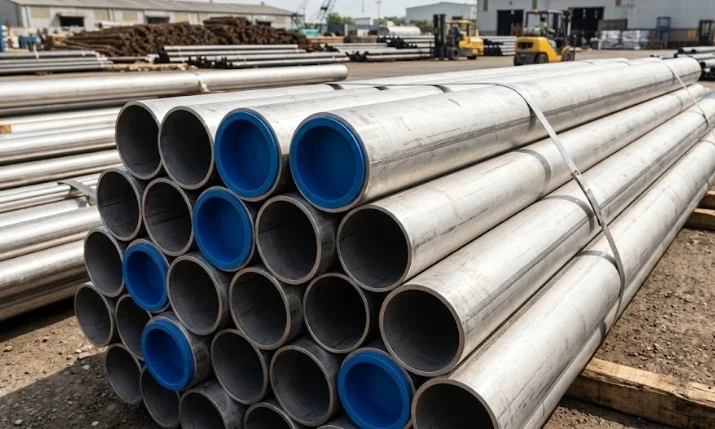
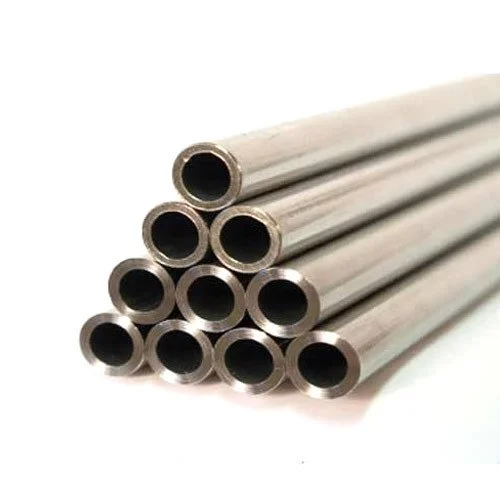
Stainless Steel 321H Pipes Specifications
| Parameter |
Details |
| Grade | 321H / UNS S32109 / 1.4878, also dual-certified 321/321H |
| Titanium | 4 × (C + N) minimum, 0.70% maximum (A312) |
| Product forms | Seamless, TIG welded, EFW |
| Pipe size | ⅛" NPS to 24" NPS, larger on request |
| Wall thickness | 1.65 mm to 40 mm |
| Schedules | 10S, 40S, 80S, 160, XXS and custom |
| Heat treatment | Solution annealed at or above the minimum temperature in the standard |
| Grain size | ASTM No. 7 or coarser |
| Length | Single random, double random, cut length up to 12 m |
| Ends | Plain, beveled |
| Surface | Annealed and pickled |
| Tests | Chemical analysis, tensile, flattening, hydrotest or eddy current, grain size, PMI |
| Extra tests on request | IGC, ultrasonic, radiography |
| Documents | EN 10204 3.1 mill certificate, inspection reports |
Stainless Steel 321H Pipes Standards
| Standard |
What it covers |
| ASTM A312 / ASME SA312 | Seamless and welded austenitic pipe, TP321H |
| ASTM A376 / ASME SA376 | Seamless pipe for high-temperature central-station service |
| ASTM A213 / ASME SA213 | Seamless boiler, superheater and heat exchanger tubes |
| ASTM A249 / ASME SA249 | Welded boiler and heat exchanger tubes |
| ASME B36.19M | Dimensions of stainless steel pipe |
| ASME B31.1 / B31.3 | Power piping and process piping design |
| NACE SP0170 | Protecting austenitic stainless steel from polythionic acid cracking during refinery shutdowns |
| EN 10216-5 | European seamless stainless tubes, including 1.4878 |
| JIS G3459 | Japanese stainless steel pipes |
Material and Grades of Stainless Steel 321H Pipes
321H is one of the "H" modifications of the standard grades, which ASTM A312 says are intended for service where creep and stress rupture properties are important. Three controls make it what it is: carbon between 0.04% and 0.10%, titanium of at least four times carbon plus nitrogen, and a grain size of ASTM No. 7 or coarser.
The solution anneal matters as much as the chemistry. Annealing at high temperature dissolves carbides and lets the grain grow, and that coarse grain is what resists creep. Pipe is then pickled to remove scale.
Dual certification as 321/321H is common. It means the pipe meets 321's titanium limit and 321H's carbon band together, so one stock serves both specifications. If your design calls for a stabilising heat treatment, usually for refinery use, tell us at enquiry and we will confirm what can be supplied for your project.
Stainless Steel 321H vs 321 vs 347H vs 304H Pipes: Which One Do You Need?
| Point |
321H |
321 |
347H |
304H |
| Stabiliser | Titanium | Titanium | Niobium | None |
| Carbon | 0.04 – 0.10% | 0.08% max | 0.04 – 0.10% | 0.04 – 0.10% |
| Creep strength | High | Moderate | High | Good |
| Resists sensitisation after heat | Yes | Yes | Yes | No |
| High polish | Not ideal | Not ideal | Good | Good |
| Typical use | Hot, long-life pressure lines | Hot lines at lower stress | Refinery and power lines | Hot, clean, dry service |
Choose 321H when the pipe runs hot for years and must stay corrosion resistant. Choose 321 when temperatures are lower or stress is modest. Choose 347H when you need a clean polish or the specification calls for niobium. Choose 304H when conditions are dry and there is no risk of sensitisation or wet corrosion.
Stainless Steel 321H Pipes Chemical Composition
| Element |
ASTM TP321H (%) |
EN 1.4878 (%) |
ASTM TP321, for comparison (%) |
| Carbon (C) | 0.04 – 0.10 | 0.10 max | 0.08 max |
| Manganese (Mn) | 2.00 max | 2.00 max | 2.00 max |
| Silicon (Si) | 1.00 max | 1.00 max | 1.00 max |
| Phosphorus (P) | 0.045 max | 0.045 max | 0.045 max |
| Sulphur (S) | 0.030 max | 0.015 max | 0.030 max |
| Chromium (Cr) | 17.0 – 19.0 | 17.0 – 19.0 | 17.0 – 19.0 |
| Nickel (Ni) | 9.0 – 12.0 | 9.0 – 12.0 | 9.0 – 12.0 |
| Titanium (Ti) | 4×(C+N) min, 0.70 max | 5×C min, 0.80 max | 5×(C+N) min, 0.70 max |
| Nitrogen (N) | 0.10 max | – | 0.10 max |
| Iron (Fe) | Balance | Balance | Balance |
Stainless Steel 321H Pipes Mechanical Properties
| Property |
Wall up to 3/8 inch (9.5 mm), and all welded pipe |
Seamless pipe, wall above 3/8 inch |
| Tensile strength | 515 MPa min | 480 MPa min |
| Yield strength (0.2%) | 205 MPa min | 170 MPa min |
| Elongation | 35% min | 35% min |
| Hardness | 90 HRB max (192 HBW) | 90 HRB max (192 HBW) |
| Density | About 7.9 g/cm³ | About 7.9 g/cm³ |
| Melting range | About 1400 – 1425°C | About 1400 – 1425°C |
| Magnetic response | Non-magnetic when annealed | Non-magnetic when annealed |
ASTM A312 sets lower strength minimums for seamless TP321 and TP321H pipe with walls thicker than 3/8 inch, so check which column your specification expects.
Creep Strength and Service Temperature of Stainless Steel 321H Pipes
Hot service is not one condition but several, and the right grade changes as the temperature climbs. This table shows where 321H fits.
| Service temperature |
What to expect |
| Below 425°C | Any austenitic grade works, and 304L or 316L is often the cheaper pick. |
| 425°C to 550°C | Stabilised grades such as 321 and 321H avoid sensitisation. |
| 550°C to about 800°C | The 321H range. Creep decides the design, and carbon and coarse grain do the work. |
| Up to about 900°C in air | Oxidation resistance holds, but strength is limited. |
| Above about 900°C | Look at 309, 310S or nickel alloys for scaling resistance and strength. |
| 650°C to 900°C for very long periods | Sigma phase can form and reduce toughness once the pipe cools. Plan for it. |
| Refinery shutdowns with sulphur scale | Stabilised grades resist polythionic acid cracking. Follow NACE SP0170 for handling. |
Your design code and calculation set the real limit. A pipe at the upper end of the range lives on its design life, so share the temperature, pressure and expected hours of service with us at enquiry.
Stainless Steel 321H Pipes Size and Weight Chart
Theoretical weight is (OD − Wall) × Wall × 0.02491, giving kg per metre with dimensions in mm. Real weight varies slightly within mill tolerance.
| NPS |
OD (mm) |
Sch 40S wall (mm) |
Sch 40S kg/m |
Sch 160 wall (mm) |
Sch 160 kg/m |
| 2" | 60.3 | 3.91 | 5.49 | 8.74 | 11.23 |
| 3" | 88.9 | 5.49 | 11.41 | 11.13 | 21.56 |
| 4" | 114.3 | 6.02 | 16.24 | 13.49 | 33.88 |
| 6" | 168.3 | 7.11 | 28.55 | 18.26 | 68.25 |
| 8" | 219.1 | 8.18 | 42.98 | 23.01 | 112.39 |
| 10" | 273.1 | 9.27 | 60.92 | 28.58 | 174.08 |
| 12" | 323.9 | 9.53 | 74.63 | 33.32 | 241.18 |
Stainless Steel 321H Pipes Sizes, Dimensions and Schedules
Hot pressure lines usually use thicker walls, because heat and pressure together stress the pipe. The table shows how wall changes with schedule at two sizes. DN is the metric size for each NPS.
| Schedule |
Wall at 4" / DN 100 (mm) |
Wall at 10" / DN 250 (mm) |
Typical use |
| 10S | 3.05 | 4.19 | Hot gas and flue lines at low pressure |
| 40S | 6.02 | 9.27 | Standard hot process piping |
| 80S | 8.56 | 12.70 | Steam and higher-pressure lines |
| 160 | 13.49 | 28.58 | High pressure and high temperature |
Under ASTM A312, outside diameter is held within +0.4/−0.8 mm up to 1½ inch, ±0.8 mm above 1½ and up to 4 inch, and +1.6/−0.8 mm above 4 and up to 8 inch. Wall thickness is held to −12.5%. We cut, bevel and bend pipe to your drawing.
Testing and Inspection of Stainless Steel 321H Pipes
For an H grade, the test that sets it apart is grain size. We measure it on the finished pipe and confirm it is ASTM No. 7 or coarser, since fine grain gives up creep strength. Chemical analysis then checks carbon in the 0.04–0.10% band and titanium against four times carbon plus nitrogen.
Mechanical tests confirm tensile, yield, elongation and hardness against the standard, and each length is hydrostatically tested or eddy current examined. PMI confirms the alloy before dispatch. When your project needs it, we add IGC testing to ASTM A262, ultrasonic or radiographic examination of welds, and independent third-party inspection, and the results go on the certificate.
Common Materials Supplied with Stainless Steel 321H Pipes
For high-temperature piping projects, we supply Stainless Steel 321H Pipes along with other stainless steel grades, nickel alloys, and compatible piping components. These materials are available for different industrial requirements, including heat resistance, corrosion protection, and long-term performance under demanding operating conditions.
Stainless Steel 321 and 347H: Stabilised grades used in high-temperature industrial applications.
Stainless Steel 304H and 316H: Suitable for elevated-temperature service, with 316H offering additional resistance to many corrosive environments.
Stainless Steel 309H and 310S: Designed for applications involving intense heat, including furnace and heat-treatment equipment.
Alloy 800H and 800HT: Nickel-iron-chromium alloys used in high-temperature processing systems.
Inconel Alloy 625: A nickel-based alloy offering high strength and resistance to severe corrosion.
Pipe Fittings and Flanges: Available in compatible materials, including bends, tees, reducers, and flanges for piping installations.
As experienced Stainless Steel 321H Pipes Suppliers, we support industrial requirements with material options and piping components selected according to the required specifications and operating conditions.
Applications of Stainless Steel 321H Pipes
- Oil Refining: Heater, reformer and hydroprocessing piping that runs hot for years.
- Fluid Catalytic Cracking Units: Hot transfer lines and flue gas piping.
- Steam Reformers and Hydrogen Plants: Hot outlet headers and process lines.
- Ethylene and Petrochemical Furnaces: Cracking furnace piping and high-temperature process lines.
- Power Generation: Superheater, reheater and hot steam piping.
- Waste Heat Recovery: Boiler tubes and hot gas ducts.
- Heat Treatment Furnaces: Radiant tubes and furnace piping.
- Chemical Processing: Hot transfer lines for gases and process fluids.
Why Choose Us as Your Stainless Steel 321H Pipes Manufacturer in India?
We have been manufacturing and exporting industrial pipes since 2005, with a focus on quality and reliable supply. Our ISO 9001:2015 and applicable TÜV certifications reflect our commitment to maintaining quality standards. With a monthly supply capacity of up to 100 tons, we can handle both small orders and large project requirements. We also help you choose the right pipe specifications based on your application and technical needs.
Quality checks are important when working with Stainless Steel 321H Pipes for high-temperature applications. We focus on material composition, required testing, and documentation to help ensure the pipes meet the specified requirements. We supply sizes from ⅛ inch to 24 inches, with seamless and welded options, different schedules, and finishes to suit your needs. Being a Stainless Steel 321H Pipes Supplier in India, we also support material selection and documentation based on your project specifications.
We can also supply other stainless steel, duplex, alloy steel, and nickel alloy pipes and tubes for related project requirements. Our export network covers 85+ countries, and we coordinate material certificates, inspection arrangements, packing, and shipping documents as required. This helps keep the ordering process simple and makes it easier to manage your piping requirements from one source.
Countries We Export Stainless Steel 321H Pipes To
Our Stainless Steel 321H Pipes reach industrial customers in more than 85 countries. We support international projects that need heat-resistant piping for refineries, power plants, petrochemical facilities, and other high-temperature applications. From selecting pipe dimensions to preparing export documents, we coordinate each order according to its specifications and destination.
Middle East: UAE, Saudi Arabia, Qatar, Oman, Kuwait, and Bahrain.
Europe: Germany, Italy, France, the United Kingdom, Spain, the Netherlands, Belgium, and Poland.
Asia-Pacific: Japan, South Korea, Australia, Singapore, Malaysia, Indonesia, Thailand, and Vietnam.
North and South America: USA, Canada, Mexico, Brazil, and Chile.
Africa: South Africa, Egypt, Nigeria, and Kenya.
South Asia: Bangladesh, Nepal, and Sri Lanka.
For international shipments, we arrange suitable export packing and provide material test certificates and shipping documents according to order requirements. Third-party inspections and additional certification can also be coordinated when specified. This approach helps ensure that Stainless Steel 321H Pipes arrive with the documentation needed for material verification and project records.